
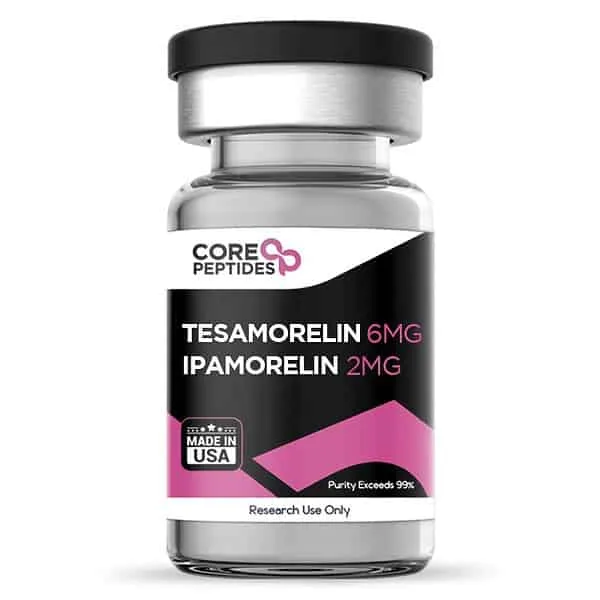
A Researcher’s Guide to the Tesamorelin & Ipamorelin Blend (8mg)
Evaluating a Tesamorelin & Ipamorelin blend requires a deep dive into chemical purity, compound synergy, and strict laboratory standards. In the research space, combining a Growth Hormone-Releasing Hormone (GHRH) with a Growth Hormone Secretagogue Receptor (GHSR) agonist is a highly studied mechanism.
This product guide breaks down the science, quality metrics, and sourcing protocols for the Tesamorelin / Ipamorelin blend (8mg) to ensure your laboratory receives reliable, high-purity compounds.
Quick Facts & Product Highlights
-
Product Type: Combined Peptide Blend (Lyophilized Powder)
-
Total Formulation: 8mg per vial [verify precise ratio split, e.g., 5mg/3mg, with Core Peptides]
-
Primary Compounds: Tesamorelin (GHRH analogue) and Ipamorelin (ghrelin receptor mimetic)
-
Target Purity: Minimum 99% verified by HPLC and Mass Spectrometry
-
Format: Vacuum-sealed, sterile glass vial with a flip-off cap
-
Storage Requirements: Store at -20°C for long-term stability; 2°C to 8°C for short-term use
-
Intended Use: In vitro laboratory research and analytical testing only; not for human or veterinary use
-
Best-Fit Buyer: Qualified institutional researchers, biotechs, and laboratory procurement specialists
What the Product Is
The tesamorelin ipamorelin blend is a dual-action peptide formulation designed to study growth hormone regulation pathways. By combining two distinct secretagogues, researchers can observe cross-talk between separate cellular receptors.
Understanding the Components
-
Tesamorelin: This is a synthetic analogue of Growth Hormone-Releasing Hormone (GHRH). It features a modified N-terminus structure compared to endogenous GHRH, which gives it greater resistance to enzymatic degradation in experimental models.
-
Ipamorelin: This is a selective pentapeptide that acts as a ghrelin receptor agonist. Unlike older compounds in its class, it specifically targets the growth hormone secretagogue receptor without significantly elevating cortisol, prolactin, or ACTH levels during assays.
When these two agents are mixed into a single 8mg vial, they are preserved via lyophilization (freeze-drying). This creates a stable, solid “cake” at the bottom of the vial that resists degradation until reconstitution.
Key Benefits and Research Use Cases
In comparative cellular biology, researchers often study an ipamorelin tesamorelin blend to observe how complementary pathways operate simultaneously. Because the two peptides bind to different receptors, their combined mechanics are a frequent focal point in endocrine research.
-
Dual-Pathway Stimulation: Tesamorelin activates the GHRH receptor, while Ipamorelin triggers the ghrelin receptor. Scientists study this combination to analyze downstream signaling amplification.
-
Selectivity Assays: Researchers use Ipamorelin within the blend to monitor metabolic responses without the compounding variables of broader hormone spikes.
-
Structural Preservation Study: Tesamorelin has been extensively evaluated in laboratory settings for its impact on lipid profiles and adipose tissue pathways at the cellular level.
Quality, Purity, and Testing Standards
When purchasing an ipamorelin/tesamorelin blend, structural purity is the single most critical variable. Minor structural variations or leftover synthesis reagents can completely invalidate assay outcomes.
+--------------------------------------------------------------+
|               Peptide Purity Verification                    |
+--------------------------------------------------------------+
|  [ Expected Peak: >99% Purity via HPLC ]                     |
|                                                              |
|       /\                                                     |
|      /  \   <-- Sharp, symmetrical target peptide peak       |
|     /    \                                                   |
|____/      \_______________________                           |
|  Baseline (No secondary peaks or impurity traces)            |
+--------------------------------------------------------------+
Essential Analytical Testing
-
High-Performance Liquid Chromatography (HPLC): This process separates the components of the peptide mixture to determine exact purity. High-quality batches show a clean, sharp peak with a value exceeding 99%. Small, secondary peaks indicate impurities.
-
Mass Spectrometry (MS): While HPLC determines purity, MS verifies the precise molecular weight of both the Tesamorelin and Ipamorelin chains, ensuring the correct sequence was synthesized.
How to Evaluate This Product Before Buying
Before completing a transaction for a tesamorelin and ipamorelin blend, you should verify the vendor’s quality assurance framework. A trustworthy supplier provides raw analytical data rather than vague performance guarantees.
Step-by-Step Verification Checklist
-
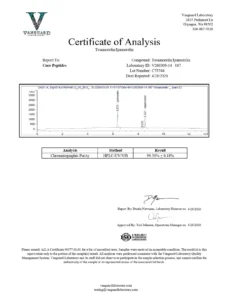
Audit the Certificate of Analysis (COA): Always demand a batch-specific COA. Ensure the document is recent and references the exact batch number on your vial.
-
Check for Independent Testing: Look for testing conducted by an external, neutral third-party laboratory located within a strictly regulated jurisdiction.
-
Confirm the Intended Use Labeling: Reputable vendors explicitly label these items as “Research Chemicals” or “For Laboratory Research Use Only.” Avoid vendors using ambiguous marketing language that implies consumer use.
-
Examine the Physical Presentation: Upon delivery, the lyophilized powder should form a solid, uniform white cake or pellet. A broken, yellowed, or melting cake suggests moisture contamination or poor vacuum sealing during manufacturing.
Storage, Handling, and Usage Considerations
Maintaining the structural integrity of your tesamorelin + ipamorelin blend requires strict adherence to temperature and handling protocols. Peptides are held together by fragile peptide bonds that easily break down under environmental stress.
Temperature Protocols
-
Lyophilized Powder (Unreconstituted): Store at -20°C for long-term storage up to 24 months. If the compound will be used within a few weeks, standard refrigeration at 2°C to 8°C is acceptable.
-
Reconstituted Solution: Once a liquid bacteriostatic medium is added, the peptide becomes highly fragile. It must be stored between 2°C to 8°C and used within the specific window determined by your laboratory protocol [verify exact lifespan with Core Peptides]. Never freeze a peptide after it has been reconstituted.
Handling Precautions
When preparing the tesamorelin ipamorelin blend for sale for an assay, introduce the reconstitution liquid slowly down the inner glass wall of the vial. Do not spray liquid directly onto the powder. Avoid shaking or violently agitating the vial; instead, gently swirl it in a circular motion until the solution is completely clear and free of particulates.
Expert Insight & Pro Tip
Pro Tip: When conducting comparative assays with multi-peptide blends, always check the batch ratio. An 8mg total mass can be blended in variations like a 5mg:3mg or 4mg:4mg split. Small deviations in the baseline ratio between different batches can alter your concentration math during reconstitution. Always note the precise structural split on the batch COA before calibrating your laboratory equipment.
Why Choose CorePeptidesOfficial.com
Sourcing your tesamorelin blend from CorePeptidesOfficial.com ensures your laboratory receives compounds manufactured under stringent quality control parameters.
-
Uncompromising Testing: Every batch undergoes rigorous third-party testing via HPLC and Mass Spectrometry to guarantee a purity profile of 99% or greater.
-
Total Transparency: We match our inventory to verifiable Certificates of Analysis, allowing researchers to trace the batch data of their specific vials.
-
Cold-Chain Integrity: Our packaging and shipping pipelines protect fragile lyophilized structures from extreme temperature exposure and light degradation during transit.
Common Mistakes to Avoid
-
Accepting Expired COAs: Using a generic or outdated testing sheet across multiple manufacturing runs hides degradation trends between batches.
-
Aggressive Mixing: Mechanical agitation via vortex mixers can shear the delicate peptide bonds of both Tesamorelin and Ipamorelin, rendering the solution useless for accurate research.
-
Inadequate Temperature Controls: Leaving vials at room temperature or exposed to direct sunlight accelerates peptide hydrolysis, rapidly decreasing the compound’s purity.
Final Buying Guidance
When buying a tesamorelin ipamorelin peptide blend, prioritize security, data verification, and legal compliance. Ensure your facility has the appropriate storage apparatus (-20°C freezers) and reconstitution media ready before checkout. Verify the exact batch number and review the corresponding third-party data sheets to ensure your laboratory receives the exact purity required for precise, reproducible research results.
Frequently Asked Questions
- What is the exact ratio of Tesamorelin to Ipamorelin in this 8mg blend? The total peptide mass inside the vial is 8mg. The exact structural ratio split between the two compounds should be verified directly via the specific batch COA or by contacting [verify with Core Peptides] to ensure precise laboratory dosing calculations.
- Can this product be used for human therapeutic purposes? No. This blend is synthesized strictly for in vitro laboratory research, analytical testing, and imaging studies. It is not approved for human or veterinary administration, and therapeutic outcomes cannot be guaranteed.
- How should I store the vial if my laboratory freezer is full? For short-term periods under 4 weeks, the lyophilized powder can be stored in a standard medical refrigerator between 2°C and 8°C. For any duration extending past a month, a consistent temperature of -20°C is required to prevent gradual peptide degradation.
- What should I do if the peptide cake arrives cracked or broken? A cracked or crumbled peptide cake is a common occurrence caused by physical vibration during transit. As long as the vacuum seal remains intact, the powder remains completely sterile, dry, and safe for research use.
- How can I confirm that my specific batch has a purity rating above 99%? You can confirm this by matching the batch number printed on your vial’s label with the official third-party HPLC report hosted on CorePeptidesOfficial.com. Look for a clean, single peak representing the targeted compounds on the chromatogram graph.
Certificate of Analysis
Be the first to review “Tesamorelin & Ipamorelin Blend (8mg)”
Related products
Peptides Blends
Peptides Blends
Peptides Blends
Peptides Blends
Peptides Blends
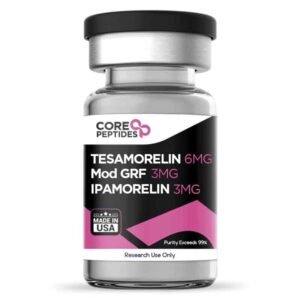
Tesamorelin & CJC-1295 (Mod GRF 1-29) & Ipamorelin Blend (12mg)
Peptides Blends
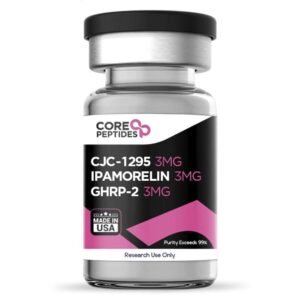
CJC-1295 ( Mod GRF 1-29 ) & Ipamorelin & GHRP-2 Blend ( 9mg )
Peptides Blends
Reviews
There are no reviews yet.