
Fragment 176-191 & Mod GRF 1-29 & Ipamorelin Blend: Ultimate Research Guide
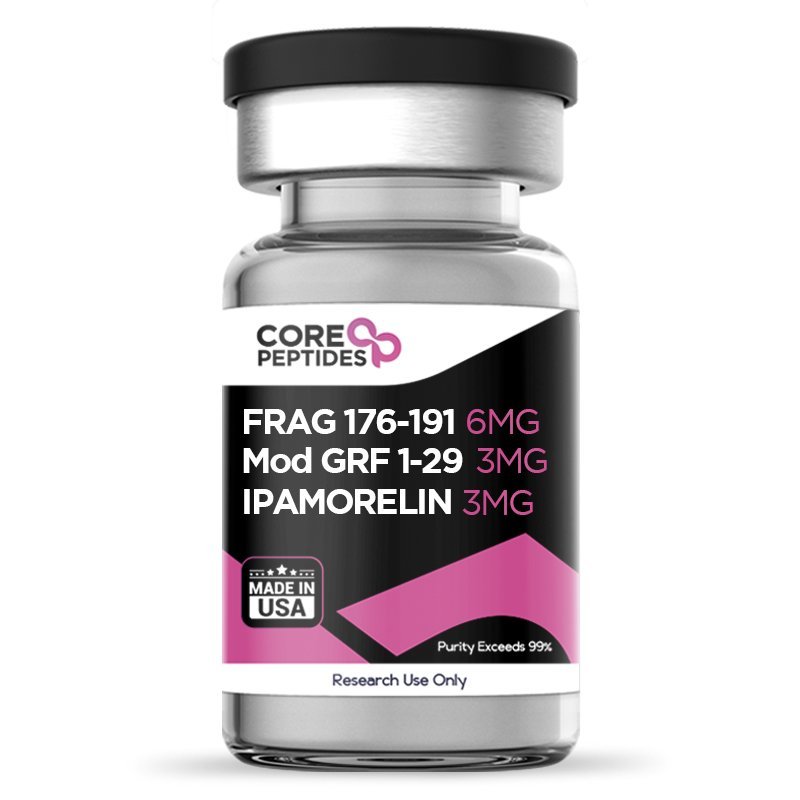
In the rapidly evolving landscape of laboratory biochemicals, the Fragment 176-191 & Mod GRF 1-29 & Ipamorelin Blend represents one of the most sophisticated multi-peptide formulations currently available for scientific study. By combining three distinct synthetic peptide sequences into a single 12mg vial, this pre-formulated blend offers researchers a streamlined approach to investigating synergistic cellular pathways.
When conducting advanced in vitro or in vivo research, understanding the precise mechanisms, purity benchmarks, and structural characteristics of this compound is critical. This comprehensive guide provides an objective breakdown of the blend to help you make an informed, compliant, and secure purchasing decision for your laboratory.
Product Highlights & Quick Facts
Before diving into the detailed molecular mechanisms, review the essential baseline specifications for this research compound:
-
Product Type: Multi-Peptide Blend (Synergistic Formulation)
-
Total Content Per Vial: 12mg total lyophilized powder [verify exact structural ratio per peptide with brand]
-
Constituent Compounds: Fragment 176-191, Modified GRF 1-29 (CJC-1295 without DAC), and Ipamorelin
-
Primary Intended Use: In vitro laboratory research and comparative analytical studies only
-
Physical Format: Lyophilized (freeze-dried) white cake/powder
-
Purity Standard: Minimum 98% purity verified via HPLC and Mass Spectrometry
-
Storage Requirements: Stable at room temperature for short-term shipping; requires long-term storage at -20°C
-
Best-Fit Buyer: Professional researchers, laboratory procurement officers, and institutional biochemists requiring certified, high-purity chemical reagents
What the Product Is
The Fragment 176-191 & Mod GRF 1-29 & Ipamorelin Blend is a specialized chemical matrix designed for comparative research applications. Rather than sourcing, measuring, and combining individual peptide sequences manually—which introduces a high margin of measurement error—this formulation provides a fixed, highly accurate distribution of three distinct growth hormone-releasing and lipolytic analogues.
       [ 12mg Synergistic Research Blend ]
                       │
       ┌───────────────┼───────────────┐
       ▼               ▼               ▼
Fragment 176-191   Mod GRF 1-29   Ipamorelin
(Lipolytic Domain)  (GHRH Agonist) (GHRP Mimetic)
To understand the complete profile of the blend, it is necessary to examine each constituent component:
-
Fragment 176-191: This peptide is a specific synthetic sub-functional domain of the C-terminal region of human growth hormone (hGH). It isolates the specific amino acid sequence responsible for lipolytic signaling pathways without stimulating the systemic insulin-like growth factor-1 (IGF-1) elevations or glycemic alterations associated with the full-length hormone.
-
Mod GRF 1-29: Also widely known as Modified Growth Hormone Releasing Factor 1-29 (or CJC-1295 without DAC), this compound is a synthetic 29-amino acid analogue of endogenous Growth Hormone-Releasing Hormone (GHRH). The strategic modification of four specific amino acids in its structure increases its metabolic stability during in vitro assays compared to natural GHRH.
-
Ipamorelin: A highly selective pentapeptide that functions as a growth hormone secretagogue receptor (GHSR) agonist. It mimics endogenous ghrelin binding to stimulate cellular secretagogue pathways without triggering the collateral release of cortisol, prolactin, or aldosterone often observed with older peptide generations.
Key Benefits and Use Cases in Research
When evaluating the Fragment 176-191 & Mod GRF 1-29 & Ipamorelin Blend, researchers target several distinct biochemical pathways simultaneously. The combination is primarily studied for its multi-layered interaction with metabolic and cellular signaling models.
1. Dual-Pathway Somatotropic Interaction
In isolated models, Mod GRF 1-29 and Ipamorelin exhibit an complementary relationship. Mod GRF 1-29 triggers the initial cellular signaling cascade by binding to GHRH receptors, while Ipamorelin works concurrently to suppress somatostatin—the natural brake fluid of cellular secretagogue release. Studying these two agents together allows researchers to observe amplified signaling responses that cannot be achieved by using either agent in isolation.
2. Isolated Lipid Metabolism Modeling
Because Fragment 176-191 targets adipocyte degradation via secondary messenger pathways without interacting with the broader somatotropic axis, this blend allows for the concurrent observation of accelerated lipid breakdown alongside systemic cellular repair mechanisms. This makes it an ideal reference material for metabolic dysfunction research.
3. Increased Experimental Efficiency
Using a precision pre-formulated blend minimizes variable introduction in the lab. Researchers can establish standardized baseline values across multi-vial test cohorts without accounting for the minor mathematical errors that occur when compounding separate lyophilized powders within the same medium.
Quality, Purity, and Testing Standards
In the research chemical sector, material integrity directly dictates data validity. A minor presence of synthesis byproducts can completely skew assay outcomes or cause cellular toxicity in test models.
Core Peptides enforces strict, uncompromising quality control protocols for every batch of the Fragment 176-191 & Mod GRF 1-29 & Ipamorelin Blend:
[Raw Synthesis] ──► [HPLC Purity Verification] ──► [Mass Spec Identification] ──► [Secure Lyophilization]
-
High-Performance Liquid Chromatography (HPLC): This analytical chemistry process separates the components of the peptide mixture to verify purity levels. Every batch must meet or exceed a strict target profile of $\ge 98\%$ purity, ensuring that trailing synthesis impurities are virtually non-existent.
-
Mass Spectrometry (MS) Analysis: While HPLC determines purity, Mass Spectrometry confirms identity. This process measures the precise molecular weight of the peptide chains, verifying that the correct structural sequences of Fragment 176-191, Mod GRF 1-29, and Ipamorelin are fully present.
-
Sterility and Stability: Vials undergo precision vacuum drying and automated sealing to prevent moisture ingress, atmospheric degradation, or microbial contamination during transit and storage.
How to Evaluate This Product Before Buying
Purchasing research peptides requires close attention to transparency. Because these compounds are distributed within an unregulated open market, lab buyers must exercise caution. Use this checklist to evaluate any batch before executing a purchase order:
| Verification Factor | What to Look For | Core Peptides Standard |
| COA Transparency | Live, downloadable Certificates of Analysis matching the current batch number. | Fully accessible, verifiable independent lab data. |
| Testing Recency | Testing documentation executed within the last few months by an independent lab. | Frequently updated, batch-specific verification. |
| Physical Appearance | A solid, uniform white cake or fine white powder without discolored structural flakes. | Pure, vacuum-sealed lyophilized matter. |
| Label Accuracy | Complete chemical nomenclature detailing exact weights and intended laboratory uses. | Compliant labeling explicit about research boundaries. |
Storage, Handling, and Usage Considerations
Maintaining the structural integrity of a 12mg triple-peptide blend requires adherence to strict laboratory preservation standards. Peptides are held together by delicate peptide bonds that are highly sensitive to thermal fluctuations and kinetic shock.
-
Temperature Controls: Upon arrival, un-reconstituted (dry) vials should be stored at 2–8°C for short-term projects or maintained at -20°C for long-term storage up to 24 months. Avoid frost-free freezers, as the consistent temperature cycles can degrade the compound.
-
Reconstitution Handling: When introducing a laboratory solvent, such as Sterile Bacteriostatic Water, always aim the liquid down the inner glass wall of the vial. Never drop liquid directly onto the lyophilized cake.
-
Kinetic Exposure: Do not shake or aggressively agitate the vial to accelerate dissolution. Gently swirl the vial in a slow, circular motion until the liquid is fully transparent. Aggressive shaking can break the molecular structures, rendering the formulation inert.
Important Laboratory Safety Note: This compound is manufactured, synthesized, and distributed strictly for laboratory research, in vitro validation, and animal testing models. It is not approved for human consumption, therapeutic interventions, or medical diagnostics. Ensure proper personal protective equipment (PPE) is worn during handling.
Expert Insight: Managing Multi-Peptide Solubilities
Pro Tip for Researchers: Because this blend contains three separate peptide structures, they may dissolve at slightly different rates based on the pH value of your reconstitution medium. If you observe tiny, microscopic particles suspended in your solution after initial reconstitution, do not panic or shake the vial. Place the vial in a cold environment (2–8°C) for 1–2 hours. The cold temperature and extended time will allow the individual sequences to achieve complete thermodynamic equilibrium and enter full solution smoothly without structural damage.
Why Choose CorePeptidesOfficial.com?
Core Peptides stands as a premier global supplier of research-grade biochemicals because we refuse to cut corners. We recognize that your research data relies entirely on the purity of your raw materials.
-
Uncompromising Testing: We do not rely on generic manufacturer statements. Every single batch is validated via independent third-party domestic laboratories.
-
Cold-Chain Integrity: Our handling facilities process and store all inventory within tightly controlled environments to prevent premature degradation.
-
Global Shipping Reliability: We use heavy-duty, protective packaging to shield your compounds from physical shocks and temperature extremes during worldwide transit.
-
Complete Transparency: Our product lines are backed by clear documentation, responsive technical support, and transparent batch tracking records.
Common Mistakes to Avoid When Purchasing
-
Chasing the Lowest Market Price: Low-cost peptides almost always signify compromised synthesis standards, under-dosed vials, or third-party test configurations that have been fabricated or copied.
-
Ignoring Batch Numbers: If a website displays a single static COA from years ago, you cannot verify the purity of the specific batch you are ordering. Always look for current batch numbers.
-
Assuming Pre-Mixed Ratios are Universal: Different labs use different ratios. Always confirm the exact ratio breakdown of the 12mg formulation with the brand’s support team before designing your study protocols.
Final Buying Guidance
Selecting an advanced multi-peptide formulation like the Fragment 176-191 & Mod GRF 1-29 & Ipamorelin Blend can significantly optimize your lab’s workflow, lower baseline overhead costs, and yield high-quality comparative data. However, these benefits are only achieved if the compound’s purity is completely guaranteed.
Before finalizing your order at checkout, double-check that you have confirmed the storage capacity of your lab freezer and reviewed the latest batch documentation available on our portal.
If you are ready to secure premium-grade reagents for your upcoming study, navigate to our product catalog to complete your purchase, or contact our dedicated laboratory support team for bulk procurement requests.
Frequently Asked Questions
- What is the exact ratio of the three peptides in the 12mg blend? The 12mg total mass is distributed across Fragment 176-191, Mod GRF 1-29, and Ipamorelin according to strict laboratory standards. Please [verify exact structural ratio per peptide with brand] directly through our technical specification sheet to ensure precise calculations for your target formulas.
- Can this blend be kept at room temperature during shipping? Yes. In its lyophilized (freeze-dried) state, the peptide structure can tolerate room-temperature transit environments for short periods without degrading. However, it should be immediately placed into a stable cold-storage environment (-20°C is highly recommended) upon arrival at your destination facility.
- What is the difference between Mod GRF 1-29 and CJC-1295 with DAC? Mod GRF 1-29 is structurally identical to CJC-1295 without the addition of the Affinity Complex (DAC). This means it creates normal, short-duration pulsatile cellular releases rather than prolonged, continuous releases, giving researchers significantly tighter control over the timing of their experimental data windows.
- What fluid should be used to reconstitute this blend for laboratory analysis? Most in vitro and in vivo studies utilize Sterile Bacteriostatic Water or Sterile Normal Saline ($0.9\%$ Sodium Chloride) for reconstitution, depending on the specific sensitivity requirements of your downstream testing assay.
- How can I access the third-party lab testing results for my order? Every shipment is linked to a specific production batch. You can easily cross-reference your batch ID code directly on CorePeptidesOfficial.com to view or download the corresponding HPLC and Mass Spectrometry documentation.
Be the first to review “Fragment 176-191 & Mod GRF 1-29 & Ipamorelin Blend (12mg)”
Related products
Peptides Blends
Peptides Blends
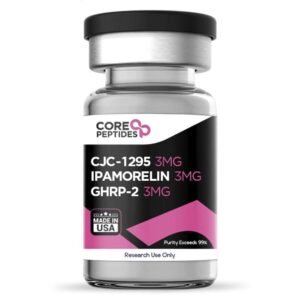
CJC-1295 ( Mod GRF 1-29 ) & Ipamorelin & GHRP-2 Blend ( 9mg )
Peptides Blends
Peptides Blends
Peptides Blends
Peptides Blends
Peptides Blends
Peptides Blends
Reviews
There are no reviews yet.