
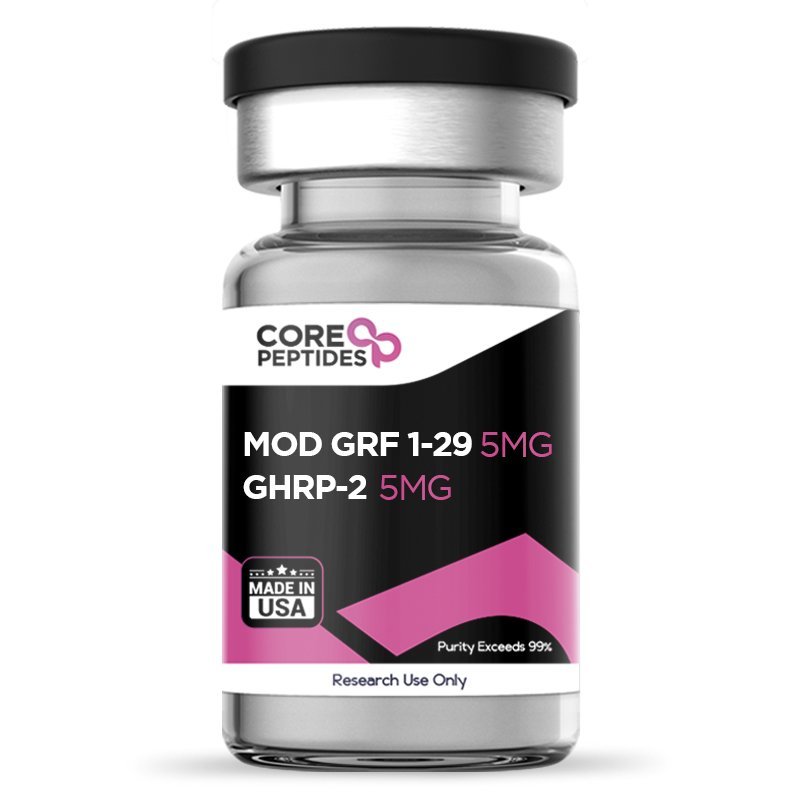
Mod GRF 1-29 & GHRP-2 Blend Buying Guide
The Mod GRF 1-29 & GHRP-2 Blend has become one of the most widely studied combinations in contemporary cellular and biochemical research. By pairing a Growth Hormone Releasing Hormone (GHRH) analog with a Growth Hormone Releasing Peptide (GHRP), researchers can study the synergistic mechanisms of growth hormone secretagogues.
When sourcing compounds for laboratory environments, precision and purity are paramount. This guide provides a transparent evaluation of the 10mg blend, detailing its chemical structure, quality benchmarks, and essential handling protocols.
Product Highlights & Quick Facts
-
Product Type: Lyophilized (freeze-dried) peptide blend.
-
Composition: Modified GRF 1-29 and GHRP-2 [verify ratio, e.g., 5mg:5mg or alternative with brand].
-
Total Mass: 10mg per vial.
-
Target Purity: Minimum 98% via HPLC and Mass Spectrometry testing [verify exact target batch purity with brand].
-
Format: Sterile, vacuum-sealed glass vial.
-
Primary Intended Use: In vitro and in vivo laboratory research only. Not for human consumption or diagnostic procedures.
-
Optimal Storage: Lyophilized powder is stable at room temperature for short periods but should be stored at -20°C for long-term stability.
-
Best-Fit Buyer: Independent researchers, university laboratories, and biotech procurement officers seeking validated, high-purity chemical reagents.
What the Product Is
The Mod GRF 1-29 & GHRP-2 Blend is a dual-action formulation designed for comparative metabolic and cellular signaling studies. To understand how the blend functions, it helps to break down each constituent compound:
-
Mod GRF 1-29 (Modified GRF 1-29): This is a 29-amino acid peptide that mimics the natural Growth Hormone Releasing Hormone (GHRH). The “modified” designation means four specific amino acids in its chain have been substituted. These changes improve its metabolic stability in vitro compared to the original, short-lived Sermorelin molecule.
-
GHRP-2 (Growth Hormone Releasing Peptide-2): This is a synthetic hexapeptide classified as a ghrelin receptor agonist. It acts via a completely different cellular pathway than GHRH, targeting the growth hormone secretagogue receptor (GHS-R).
When blended together into a single 10mg vial, these two compounds allow researchers to observe simultaneous, complementary pathways of cellular signaling.
Key Research Benefits and Use Cases
In laboratory models, combining a GHRH analog with a GHRP yields specific experimental advantages that cannot be achieved by studying either peptide in isolation.
The Synergistic Signaling Phenomenon
The primary objective of using a mod grf 1-29 peptide alongside GHRP-2 is to observe receptor synergy. Mod GRF 1-29 triggers the natural release cascade at the pituitary level, while GHRP-2 amplifies this signal and inhibits somatostatin (a hormone that blocks growth hormone release). Researchers study this interaction to map how distinct cellular receptors amplify or mute biological signals when triggered concurrently.
Enhanced Molecular Stability
A common hurdle in peptide research is the rapid degradation of natural peptides by enzymes. Because this blend uses the modified version of GRF 1-29, the structural integrity of the peptide chain holds up longer under experimental conditions. This allows for more precise data collection over extended observation windows.
Pituitary and Metabolic Modeling
This blend is widely utilized in endocrine system modeling. Researchers use it to investigate cell signaling, cellular repair mechanisms, lipid metabolism pathways, and the systemic impacts of controlled secretagogue exposure in animal models.
Quality, Purity, and Testing Standards
In the research chemical industry, small variances in purity can ruin an entire study. When you buy mod grf 1-29 blends, verifying the underlying analytical chemistry is the only way to protect your budget and your data.
+------------------------+---------------------------------------------------------+
| Testing Benchmark      | Standard Expectation for Reliable Lab Results           |
+------------------------+---------------------------------------------------------+
| Purity Rating          | ≥ 98.0% analytical purity via HPLC                      |
| Identity Verification  | Confirmed molecular weight via Mass Spectrometry (MS)  |
| Visual Appearance      | Uniform, white lyophilized cake or powder               |
| Structural Integrity   | Vacuum-sealed vial free of moisture or discoloration    |
+------------------------+---------------------------------------------------------+
Every legitimate batch must be backed by a verifiable Certificate of Analysis (COA). High-Performance Liquid Chromatography (HPLC) ensures that no unexpected synthesis byproducts or degradation compounds remain in the vial. Mass Spectrometry (MS) confirms that the exact sequence of amino acids is present and correctly structured.
How to Evaluate This Product Before Buying
To ensure you are receiving a genuine, unadulterated compound, run through this pre-purchase verification checklist:
-
Request the Latest COA: Do not rely on historical or generic lab reports. Ensure the COA matches the current batch number listed on your product vial.
-
Look for Independent Validation: Third-party testing by an un-affiliated, domestic analytical laboratory carries far more weight than in-house manufacturer claims.
-
Examine Label Compliance: Legitimate research peptides will clearly state “For Research Use Only” or “Not for Human Consumption” on the label. The absence of these warnings is a major red flag regarding the vendor’s regulatory compliance.
-
Check Shipping Standards: Peptides are delicate chains of amino acids. Ensure your vendor utilizes temperature-controlled packaging or climate-conscious dispatching practices to prevent thermal degradation during transit.
Storage, Handling, and Usage Considerations
Proper laboratory protocol is essential to maintain the integrity of your Mod GRF 1-29 & GHRP-2 Blend.
Initial Storage
Upon arrival, the lyophilized powder should be stored in a freezer at -20°C for maximum shelf life. If the compound will be used within a few weeks, standard refrigeration at 2°C to 8°C is acceptable. Avoid frequent temperature fluctuations.
Reconstitution Protocol
When preparing the blend for experimental use, the introduction of a sterile bacteriostatic or laboratory-grade solvent is required [verify specific recommended volume and solvent type with brand].
-
Allow the vial to reach room temperature naturally before introducing liquid.
-
Clean the rubber stopper with an alcohol wipe.
-
Gently aim the solvent down the inside glass wall of the vial rather than spraying it directly onto the powder cake.
-
Do not shake the vial. Shaking can shear and destroy the delicate peptide bonds. Instead, gently swirl the vial in a slow, circular motion until the powder dissolves completely into a clear, colorless liquid.
Post-Reconstitution Handling
Once dissolved, the peptide blend is highly sensitive to heat and physical agitation. Store the liquid solution strictly between 2°C and 8°C. For optimal accuracy, use the reconstituted solution within the verified lifespan recommended for the batch [verify timeline, typically 14–28 days].
💡 Expert Insight / Pro Tip
When designing an experiment involving a dual-peptide blend, always factor in the “receptor saturation point.” In animal or tissue models, escalating the dosage beyond a certain threshold does not yield higher signaling returns; instead, it can cause receptor downregulation or skew your data with unintended off-target effects. Always establish a baseline curve using single-agent controls before introducing the blend to your model.
Why Choose CorePeptidesOfficial.com
At CorePeptidesOfficial.com, we understand that reliable research requires reliable reagents. We do not cut corners on transparency or supply chain integrity.
-
Batch-Specific Transparency: We provide accessible, up-to-date third-party testing documentation so you know exactly what is entering your lab.
-
Stellar Synthesis Controls: Our manufacturing processes ensure uniform distribution of both Mod GRF 1-29 and GHRP-2 within the blend, eliminating the batch-to-batch inconsistencies common with lower-tier vendors.
-
Secure, Protected Shipping: Every order is packed to minimize mechanical shock and thermal exposure during delivery, arriving at your facility ready for immediate preservation or use.
Common Mistakes to Avoid
-
Storing Reconstituted Peptides in the Freezer: Freezing a peptide after it has been mixed with a liquid solvent can cause the water molecules to expand, shearing the peptide chains and rendering the solution useless.
-
Accepting Off-White or Clumpy Discoloration: A healthy lyophilized peptide should look like a pristine white cake or uniform powder. Yellowing, moisture accumulation, or dark specks indicate contamination or advanced breakdown.
-
Conflating Modified GRF 1-29 with CJC-1295 DAC: This is a frequent point of confusion. Modified GRF 1-29 does not contain the Drug Affinity Complex (DAC). CJC-1295 with DAC has a completely different half-life and alters experimental timelines dramatically. Always confirm you are using the non-DAC, modified GRF variant for standard secretagogue modeling.
Final Buying Guidance
Investing in high-caliber materials is the best way to safeguard the validity of your laboratory findings. The Mod GRF 1-29 & GHRP-2 Blend (10mg) offers an efficient, scientifically stable method to study dual-pathway growth hormone secretagogue activity.
Before finalizing your purchase at checkout, double-check your laboratory inventory to ensure you have the appropriate storage infrastructure, sterile reconstitution solvents, and tracking protocols in place.
Ready to secure verified reagents for your upcoming project? Explore the current batch details and certifications available on CorePeptidesOfficial.com today.
Frequently Asked Questions
- What is the exact ratio of Mod GRF 1-29 to GHRP-2 in this 10mg blend? The precise ratio can vary by manufacturing batch to accommodate specific research requirements. Please [verify with brand/source] or check the product label on CorePeptidesOfficial.com for the exact milligram distribution of each peptide in the current inventory.
- Can this blend be used for human medical treatments? No. This product is synthesized strictly for laboratory research, in vitro analysis, and animal testing models. It is not approved by the FDA or other regulatory bodies for human diagnostic, therapeutic, or lifestyle purposes.
- How do I verify the third-party lab testing for my order? Every shipment is tied to a specific batch number. You can cross-reference this batch number directly against the Certificate of Analysis (COA) uploaded to CorePeptidesOfficial.com or request a digital copy from customer support.
- What should I do if my vial arrives with a broken vacuum seal? If the cap is loose or the vacuum seal appears compromised upon unpacking, do not use the compound in your experiments. Contact support immediately for a batch replacement, as exposure to ambient moisture can rapidly degrade the lyophilized peptide.
- How long does the lyophilized powder remain stable at room temperature? While the lyophilized format is designed to withstand ambient temperatures during short shipping windows, prolonged exposure to temperatures above room temperature can reduce its shelf life. It should be transferred to a cold storage unit immediately upon delivery.
Be the first to review “Mod GRF 1-29 & GHRP-2 Blend (10mg)”
Related products
Peptides Blends
Peptides Blends
Peptides Blends
Peptides Blends
Peptides Blends
Peptides Blends
Reviews
There are no reviews yet.