
Vesugen Peptide Research Guide: Evaluating the Vascular Bioregulator
In modern biochemical exploration and clinical cellular longevity studies, ultra-short synthetic peptides have emerged as powerful molecular switches. Among these miniature structures, the vesugen peptide has gained significant traction for its highly targeted interaction with vascular endothelial cells. Composed of just three strategically linked amino acids, this synthetic tripeptide offers researchers a stable, predictable, and clean mechanism to explore cellular dynamics without the confounding variables introduced by larger, complex signaling proteins.
This guide serves as an objective reference for laboratory buyers, academic scientists, and biomedical researchers seeking to evaluate vesugen, understand its documented cellular mechanisms, and establish proper validation criteria before acquisition.
Quick Facts & Vesugun Peptide Highlights
-
Product Type: Synthetic Short-Chain Peptide Bioregulator (Tripeptide).
-
Chemical Configuration: L-Lysyl-L-glutamyl-L-aspartic acid sequence (Lys-Glu-Asp).
-
Common Forms: Vesugen acetate, free-base tripeptide.
-
Molecular Formula: $C_{15}H_{26}N_{4}O_{7}$ [verify with brand/source].
-
Molecular Weight: $374.39 \text{ g/mol}$ [verify with brand/source].
-
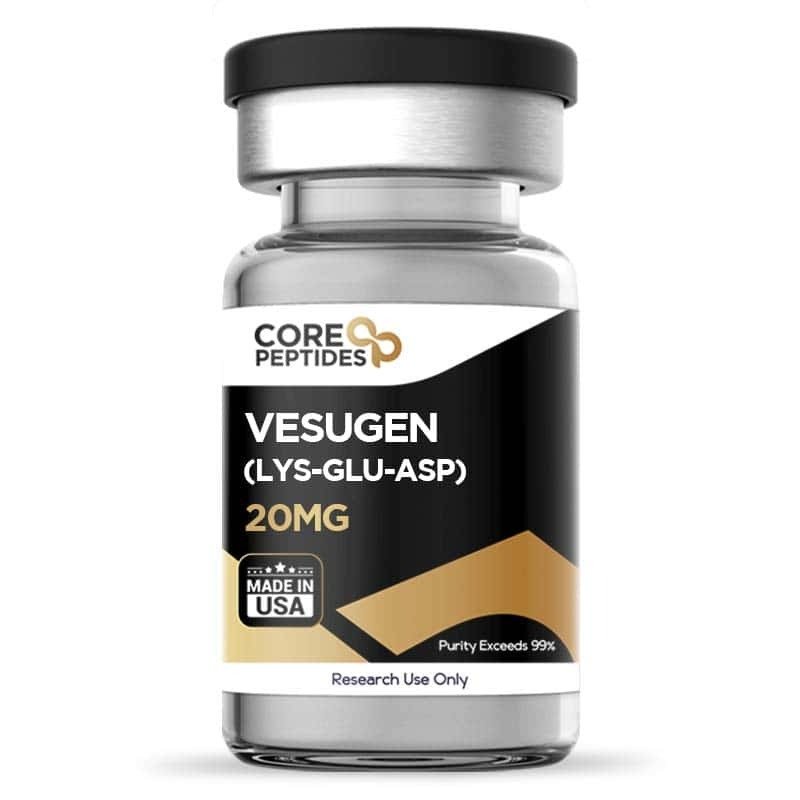
Format: 20mg lyophilized (freeze-dried) pristine white powder in a vacuum-sealed glass vial.
-
Purity Verification: Greater than or equal to 99% purity verified by independent third-party testing.
-
Intended Use: Strictly for laboratory research, chemical synthesis, and in-vitro experimental models. Not for human consumption, therapeutic intervention, or clinical use.
-
Storage Protocols: Store dry at $2^\circ\text{C}$ to $8^\circ\text{C}$ for short-term preservation, or below $-20^\circ\text{C}$ for extended stability.
What is the Vesugen Bioregulator?
The vesugen peptide belongs to a specialized class of peptide bioregulators originally conceptualized at the St. Petersburg Institute of Bioregulation and Gerontology. Unlike generic peptides that act widely across various physiological tissues, the vesugen bioregulator was custom-synthesized to interact directly with the vascular system.
Its specific amino acid triad—Lys-Glu-Asp—is small enough to pass seamlessly through cellular and nuclear membranes. Once inside the cell nucleus, models indicate it interacts directly with targeted strands of chromatin, encouraging gene transcription and protein synthesis within the vascular wall. In older or stressed tissue cultures, it helps reactivate pathways that have slowed down due to cellular aging or environmental damage.
Key Mechanisms and Documented Vesugen Benefits
When examining the biological impact of vesugen, researchers look closely at how this small molecule impacts vessel elasticity and cell turnover. The most prominent vesugen peptide benefits documented in laboratory and animal-model literature include:
1. Endothelial Cell Proliferation
The primary hallmark of vesugen is its impact on the inner lining of blood vessels, known as the endothelium. In vitro tissue assays show that adding the tripeptide helps accelerate the replication and growth of healthy endothelial cells. This makes it an important control agent for studies investigating vascular aging and vascular wall degradation.
2. Downregulation of Vascular Sclerosis Markers
As vascular tissues age or experience chronic oxidative stress, they tend to overexpress proteins that cause tissue stiffening and plaque accumulation. Animal models tracking the behavior of vesugen acetate indicate a marked reduction in vascular sclerosis markers. The compound appears to assist in maintaining the flexible, elastic properties of vessel walls by modulating local structural protein synthesis.
3. Synergistic Tissue Modeling
In broad longevity research frameworks, investigators frequently cross-reference different organ-specific bioregulators. For instance, while researchers study ovagen peptide benefits to map out liver tissue homeostasis and metabolic purification, they run parallel tests with the vesugen peptide to ensure the microscopic blood vessels supplying those organs remain healthy and functional. This combined research approach helps paint a complete picture of systemic tissue preservation.
Vesugen 20mg Quality, Purity, and Testing Standards
Because tripeptides rely entirely on their exact three-dimensional shape to interact correctly with chromatin, any manufacturing defect, trailing salt, or chemical impurity can completely alter your experimental outcomes.
Every batch available on our platform undergoes strict quality control protocols before being released:
-
High-Performance Liquid Chromatography (HPLC): This critical analytical tool tests the overall purity of the batch. A compliant batch must return a single, definitive peak matching a purity threshold of 99% or higher, proving that no unlinked amino acids or manufacturing byproducts remain in the vial.
-
Mass Spectrometry (MS): While HPLC measures purity, Mass Spectrometry confirms the absolute identity of the compound. The resulting mass profile must show an exact mass peak corresponding to the specific molecular weight of the Lys-Glu-Asp sequence.
How to Evaluate This vesugen peptide Before Buying
When searching for vesugen for sale, researchers must meticulously vet vendors to avoid altered or lower-grade materials. Always use this checklist prior to checkout:
┌────────────────────────────────────────────────────────┐
│               PRE-PURCHASE CHECKLIST                   │
├────────────────────────────────────────────────────────┤
│ 1. Traceable COA (Matching batch number on the vial)   │
│ 2. Correct Chemical Name (Vesugen acetate / Lys-Glu-Asp)│
│ 3. Physical State (Lyophilized powder in glass vial)  │
│ 4. Clear Compliance Language ("For Research Use Only") │
└────────────────────────────────────────────────────────┘
If a commercial vendor displays human intake directions or explicitly offers an unverified consumer vesugen peptide dosage chart, it is an immediate red flag that the material is not authentic, laboratory-grade stock.
Vesugen Peptide Storage, Handling, and Usage Considerations
To maintain the structural integrity of your material and ensure consistent data throughout your project, adhere to these handling guidelines:
-
Lyophilized Powder Care: Keep un-reconstituted vials stored between $2^\circ\text{C}$ and $8^\circ\text{C}$ for immediate use. For long-term archiving up to 24 months, store the vials in a deep freezer below $-20^\circ\text{C}$ to protect the peptide bonds from moisture breakdown.
-
Reconstitution Protocols: Dissolve the 20mg powder using an appropriate laboratory fluid, such as sterile bacteriostatic water or laboratory-grade phosphate-buffered saline (PBS). Gently swirl the vial until the white cake dissolves completely. Avoid shaking the vial aggressively, as severe physical impact can alter delicate peptide configurations.
-
Liquid Phase Stability: Once dissolved, the compound becomes significantly more fragile. Store reconstituted liquid solutions inside a laboratory refrigerator at $2^\circ\text{C}$ to $8^\circ\text{C}$ and utilize the solution within 10 to 14 days. Avoid repeated freeze-thaw cycles, as they cause physical shear stress to the molecules.
🔬 Expert Insight / Pro Tip
Because vesugen directly targets vascular endothelial cells, its activity in cell cultures is highly dependent on oxygen availability. If your in-vitro model simulates hypoxic (low-oxygen) conditions, ensure you establish a clear, non-peptide baseline control first. Endothelial cells naturally alter their chromatin accessibility under low oxygen, which can either amplify or obscure the direct transcriptional actions of the tripeptide bioregulator.
Why Choose CorePeptidesOfficial.com?
Core Peptides Official supports global scientific advancement by providing completely reliable, verified research tools. We secure your experimental workflows through:
-
Absolute Data Transparency: Every batch of our inventory is paired with a traceable, third-party Certificate of Analysis confirming its analytical purity and molecular identity.
-
Maximum Chemical Stability: Our advanced freeze-drying and vacuum-sealing methods remove all atmospheric moisture from our vials, preventing chemical degradation during transit.
-
Professional Logistics: We offer rapid, secure shipping along with fully encrypted checkout protocols to protect your institutional procurement data.
Common Mistakes to Avoid When Sourcing Vesugen
-
Searching for Human Intake Instructions: Because this compound is strictly prohibited for human clinical use, searching for a consumer-facing vesugen peptide dosage or typing typo-variants like vesugo into retail search boxes is scientifically invalid. Research compounds lack the compounding buffers and human safety approvals required for personal administration.
-
Confusing Vesugen with Other Bioregulators: It is easy to mix up similar-sounding names in this category. Always check the specific sequence (Lys-Glu-Asp) on the product documentation to ensure you aren’t accidentally purchasing an alternative compound like Ovagen, which targets entirely different hepatic pathways.
-
Accepting Vague Text Claims: Never rely on a supplier that simply writes “99% pure” on a web page without showing a verifiable analytical graph. Insist on seeing a real HPLC chart to protect your research from corrupted or under-dosed materials.
Final Sourcing Guidance
If your research team is launching an upcoming study on vascular cell replication, blood vessel wall elasticity, or endothelial signaling, the vesugen peptide stands out as an incredibly stable and responsive model compound.
Before completing your procurement at Core Peptides Official, ensure your facility has the appropriate cold-storage equipment and reconstitution solvents ready for your specific protocols. Select your required volume with complete confidence, knowing your research is backed by strict purity standards and verified quality metrics.
Frequently Asked Questions
What is the exact amino acid sequence of Vesugen?
Vesugen is a synthetic tripeptide consisting of three specific amino acids: L-Lysyl-L-glutamyl-L-aspartic acid, universally abbreviated in life science literature as the Lys-Glu-Asp or KED sequence.
How does Vesugen differ from natural vascular extracts?
Natural vascular extracts contain a complex mixture of various proteins, enzymes, and cellular fractions, which can cause unpredictable baseline variations in a lab setting. Vesugen is a single, isolated synthetic sequence, providing absolute chemical uniformity and highly predictable interactions in clean research models.
Is there a recommended human dosage for this peptide?
No. This product is manufactured and distributed exclusively as a laboratory research chemical. It is completely unapproved for human use, meaning there are no safe, authorized, or validated human dosage protocols available.
Why is the peptide provided in a lyophilized powder form?
Peptides are highly vulnerable to hydrolytic cleavage (breaking down in water) when kept in a liquid solution for extended periods. Lyophilization extracts all moisture while locking the molecular structure in place, ensuring maximum shelf-life during global shipping.
How can I verify the testing data for my specific batch?
Core Peptides Official provides open digital access to the specific HPLC chromatogram and Mass Spectrometry data for every production run. You can view these verification metrics directly on our online catalog or request the files from our support team prior to executing your experiment.
Be the first to review “Vesugen ( 20mg )”
Related products
Reviews
There are no reviews yet.