
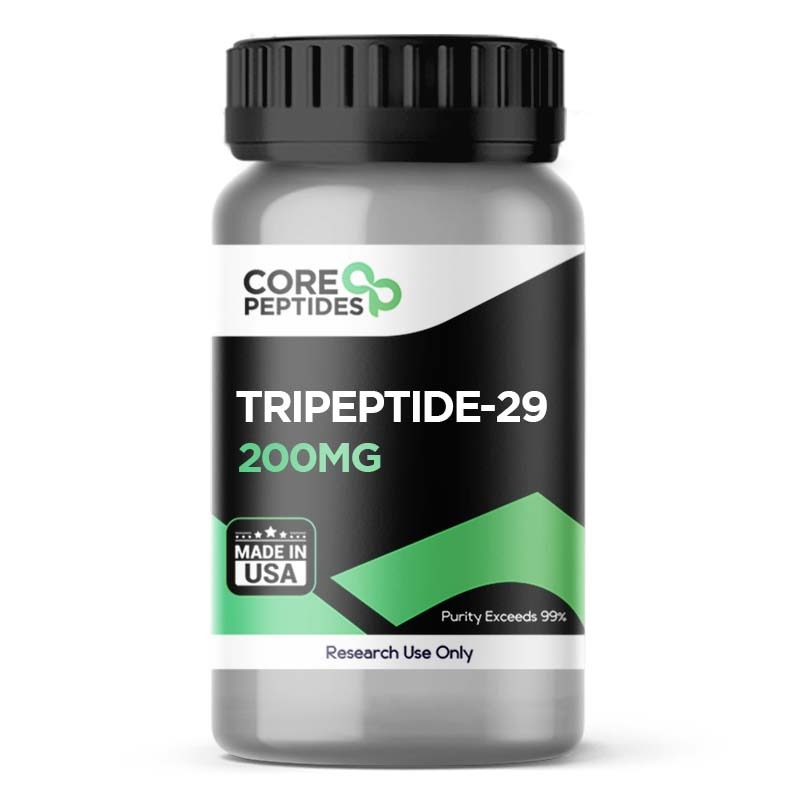

Tripeptide Injections: Research Applications of Tripeptide-29
When exploring the science of cellular tissue remodeling, researchers frequently study the pathways of tripeptide injections to observe how specific short-chain amino acid compounds interact with extracellular matrix proteins.
Tripeptide injections: Quick Facts & Highlights
-
Primary Compound: Tripeptide-29 (also known as Collagen Tripeptide).
-
Target Application: Extracellular matrix, collagen synthesis, and tissue remodeling research.
-
Format: 200mg of sterile lyophilized (freeze-dried) powder in a vacuum-sealed glass vial.
-
Purity Level: $\ge 99\%$ verified by third-party HPLC and Mass Spectrometry analysis.
-
Intended Use: Strictly for in-vitro assays and laboratory research. Not for human use, cosmetic application, or direct clinical therapy.
-
Best-Fit Buyer: Biomedical laboratories, academic researchers, and chemical procurement officers.
What is a Tripeptide? Structural Basics
To understand how research compounds behave in laboratory models, it helps to start with molecular fundamentals: what is a tripeptide?
In organic chemistry, tripeptides are organic compounds consisting of three amino acids joined by two peptide bonds. To put this in perspective, let us look at the simpler dipeptides. What are dipeptides? They are molecules made of just two amino acids joined by a single peptide bond.
A standard tripeptide structure is formed when three specific amino acid residues link together in a precise sequence. For example, the specialized gln-met-cys tripeptide consists of glutamine, methionine, and cysteine. The structure below illustrates how these short chains organize themselves molecularly:
Depending on the amino acids used, these molecules are assigned standard shorthand identifiers. Common abbreviations for this tripeptide class are derived from the single-letter or three-letter codes of their constituent amino acids (such as Gly-Pro-Hyp for Tripeptide-29).
The Peptide Family Tree
Researchers study various types of tripeptide compounds across cosmetic, metabolic, and tissue-regeneration fields. Some of the most frequently researched variations include:
-
Tripeptide-1 / Palmitoyl Tripeptide-1: Widely studied for its role in cellular signaling and tissue repair.
-
Copper Tripeptide-1 / Copper Tripeptide / Copper Tripeptide 1: Often analyzed for its high affinity for copper ions, which are essential for wound-healing models.
-
Biotinoyl Tripeptide-1: Frequently investigated for its effects on hair follicle cell dynamics.
-
Palmitoyl Tripeptide-5 / Palmitoyl Tripeptide-38: Studied for their ability to support structural integrity in dermal fibroblasts.
-
Tripeptide-29 (Tripeptide 29): A pure, highly concentrated collagen tripeptide consisting of the sequence Glycine-Proline-Hydroxyproline. It is specifically designed to mimic the fundamental building blocks of human collagen.
Key Research Applications of Tripeptide-29
The synthetic molecule tripeptide-29 is a pure collagen tripeptide that is highly stable and soluble. In laboratory models, researchers use this specific sequence to study several key physiological pathways:
Extracellular Matrix and Collagen Synthesis
In cellular cultures, Tripeptide-29 acts as an immediate precursor for collagen production. Researchers apply this compound to dermal fibroblast assays to measure how quickly cells convert raw amino acid structures into mature, stable collagen matrices.
Wound-Healing and Tissue Repair Models
Because of its small molecular size, Tripeptide-29 penetrates cellular membranes easily. This makes it a popular choice for researching rapid tissue regeneration, cell migration, and structural repair mechanisms in damaged tissue models.
Addressing Misconceptions: Weight Loss and Therapeutics
As peptides gain popularity in the public eye, several common misunderstandings have emerged regarding their target uses.
Is Tripeptide Used for Weight Loss?
A common online search trend links these compounds to metabolic pathways, with terms like tripeptide weight loss, weight loss tripeptide, or tripeptide for weight loss. Some users even ask, “which is better semaglutide or tripeptide?”
⚠️ Scientific Clarification: Tripeptide-29, tripeptide-1, and copper tripeptide 1 have no metabolic or weight-loss properties. Semaglutide is a large GLP-1 receptor agonist peptide that regulates insulin and appetite. In contrast, Tripeptide-29 is a tiny, three-amino-acid chain structurally dedicated to collagen synthesis. They belong to completely different chemical families and serve entirely different research purposes.
Commercial Cosmetics vs. Raw Research Materials
You may also run across highly rated retail products, such as:
-
Skinceuticals tripeptide r neck repair (including skinceuticals tripeptide-r neck repair reviews)
-
The inkey list tripeptide plumping lip balm (often searched as tripeptide plumping lip balm)
-
Eminence organics copper tripeptide serum
-
Beautycounter countertime tripeptide radiance serum or loreal tripeptide serum
These consumer products use low concentrations of cosmetic-grade peptides, like palmitoyl tripeptide 1, palmitoyl tripeptide 5, or a copper tripeptide 1 serum, which are blended with creams and silicones for topical use.
In contrast, the tripeptide-29 offered by Core Peptides Official is a raw, high-purity, lyophilized active pharmaceutical ingredient (API). It is designed strictly for analytical laboratory assays, not for topical cosmetic applications or personal use.
Tripeptide Injections: Quality, Purity, and Testing Standards
Because experimental results rely on precise molecular weights and clean reactions, researchers must avoid unverified materials. At Core Peptides Official, our tripeptide-29 goes through rigorous quality control steps:
-
HPLC Analysis: We test every batch to guarantee the compound meets a minimum of 99% purity. The chromatogram must show a single, clean peak, proving the product is free of manufacturing byproducts.
-
Mass Spectrometry: This test verifies the exact chemical footprint of the tripeptide structure, ensuring that the sequence matches Glycine-Proline-Hydroxyproline exactly.
How to Evaluate Sourcing Prior to Purchase
If you are wondering where to get tripeptide or how to get tripeptide that meets strict scientific standards, keep these three procurement rules in mind:
-
Look for Batch-Specific COAs: Never purchase from a vendor that does not provide a Certificate of Analysis (COA) showing third-party lab verification.
-
Verify the Physical Form: High-purity peptides are sold as dry, lyophilized cakes under vacuum. Avoid pre-mixed liquid solutions, which degrade quickly during shipping.
-
Check the Intended-Use Labels: Reputable suppliers label their products “For Research Use Only.” Avoid vendors that market these materials for direct tripeptide injections in humans.
Tripeptide Injections: Storage, Reconstitution, and Handling
To protect the structural stability of your tripeptide-29 batch, follow these handling protocols:
-
Dry Storage: Keep the vacuum-sealed vial between $2^\circ\text{C}$ and $8^\circ\text{C}$ for immediate projects. For long-term storage up to two years, freeze the vial below $-20^\circ\text{C}$.
-
Reconstitution: Gently add sterile bacteriostatic water or buffered laboratory saline to the vial. Do not shake the vial; instead, gently roll it between your palms until the white cake is completely dissolved.
-
After Reconstitution: Store reconstituted solutions in a lab refrigerator at $2^\circ\text{C}$ to $8^\circ\text{C}$ and use them within 10 to 14 days. To avoid damage from repeated freeze-thaw cycles, divide the liquid into single-use aliquots before freezing.
🔬 Expert Insight / Pro Tip
When comparing tripeptides like Tripeptide-29 to larger, hydrolyzed collagen proteins in tissue culture models, remember that cell-absorption rates are heavily influenced by molecular weight. Tripeptide-29 has a molecular weight of under $300 \text{ Da}$, allowing it to bypass cellular transport barriers that typically block larger proteins.
Why Choose CorePeptidesOfficial.com?
Core Peptides Official is a trusted partner for research facilities worldwide. We support your projects by providing:
-
High Purity: Our tripeptide-29 is verified to meet or exceed 99% analytical purity.
-
Traceable Quality: Every order includes downloadable HPLC/MS testing sheets linked directly to your product’s batch number.
-
Fast, Temperature-Controlled Shipping: We package our vials securely to ensure they remain stable throughout transit.
Common Sourcing Mistakes to Avoid
-
Confusing Structural Classes: Do not confuse dipeptides with tripeptides. Dipeptides have only two amino acids and behave differently in receptor-binding models.
-
Assuming All Peptides Aid Weight Loss: Do not buy Tripeptide-29 expecting metabolic or fat-loss results. It is structurally dedicated to extracellular matrix and collagen research.
-
Neglecting Temperature Controls: Leaving your lyophilized vials at room temperature for extended periods can cause the peptide chains to break down, compromising your research data.
Final Buying Guidance
For research teams studying tissue engineering, wound healing, or cellular collagen synthesis, tripeptide-29 is an incredibly stable and reliable model compound.
Before completing your purchase at Core Peptides Official, ensure your laboratory is stocked with the proper sterile solvents and cold-storage equipment. Order with confidence, knowing that each vial is backed by verified HPLC testing and strict quality control.
Frequently Asked Questions
What is the exact sequence of Tripeptide-29?
Tripeptide-29 is a pure synthetic sequence consisting of Glycine-Proline-Hydroxyproline (Gly-Pro-Hyp). This sequence is a key structural building block found throughout natural human collagen fibers.
What is the difference between a dipeptide and a tripeptide?
A dipeptide is made of two amino acids joined by one peptide bond, while a tripeptide consists of three amino acids linked by two peptide bonds. These structural differences change how the molecules bind to target receptors.
Can Tripeptide-29 be used for weight loss?
No. Tripeptide-29 does not have any metabolic or fat-burning properties. It is used exclusively in research focused on collagen production and tissue repair.
How should the lyophilized powder be stored?
Keep the dry powder frozen below $-20^\circ\text{C}$ for long-term storage. For short-term projects, it can be kept in a standard refrigerator between $2^\circ\text{C}$ and $8^\circ\text{C}$.
How can I access the third-party testing data for my batch?
You can download the specific HPLC and Mass Spectrometry reports directly from our quality verification portal using the batch number printed on your vial’s label.
Be the first to review “Tripeptide-29 ( 200mg )”
Related products
Reviews
There are no reviews yet.