
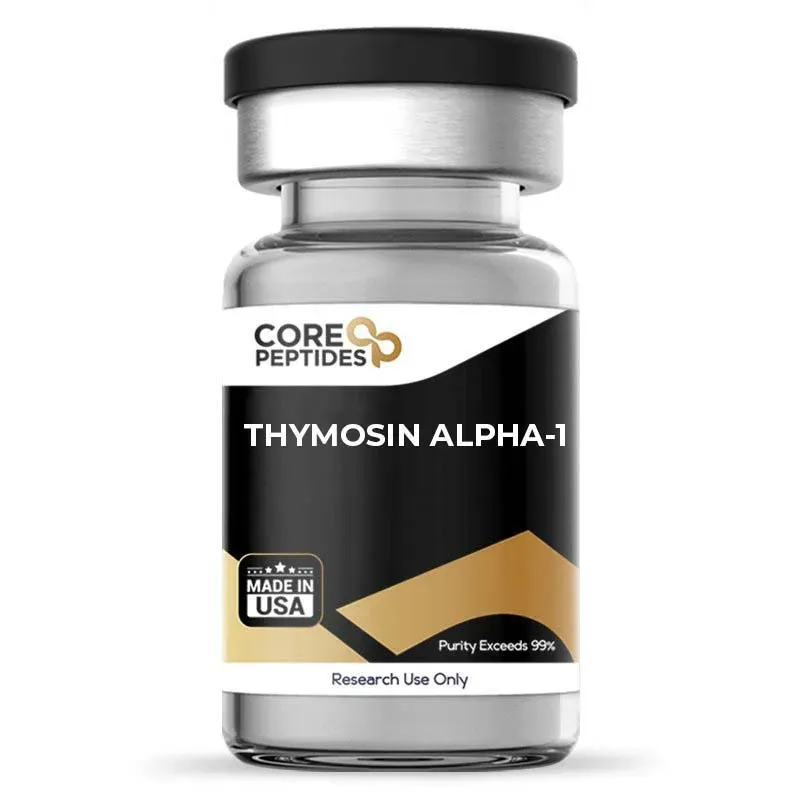
Thymosin Alpha 1 Reference & Quality Guide for Researchers
If you are looking to purchase thymosin alpha 1 for your laboratory, you already know it is one of the most heavily researched peptides in the fields of immunology and cellular biology. Also known by its shorthand designation Tα1 (or TA1 peptide), this complex molecule plays a foundational role in studying immune system adaptations, cellular signaling pathways, and T-cell differentiation.
However, sourcing biochemical reagents in the modern research space presents challenges. Subtle variations in manufacturing, purity, or stability can dramatically shift experimental data. This comprehensive guide details the core science of thymosin alpha 1, the key quality markers you must verify before purchasing, and how to safely store and handle this peptide to ensure absolute data reproducibility.
Thymosin alpha 1. Quick Facts & Highlights
-
Product Type: Highly purified synthetic peptide.
-
Chemical Name: Thymosin Alpha-1 (Tα1 / TA1).
-
Amino Acid Sequence: A 28-amino acid chain derived from thymosin fraction 5 [Ac-Ser-Asp-Ala-Ala-Val-Asp-Thr-Ser-Ser-Glu-Ile-Thr-Thr-Lys-Asp-Leu-Lys-Glu-Lys-Lys-Glu-Val-Val-Glu-Glu-Ala-Glu-Asn-OH].
-
Molecular Weight: 3108.3 g/mol.
-
Available Formats: Lyophilized (freeze-dried) powder in 5mg and 10mg vials [verify with brand/source].
-
Purity Standard: Greater than or equal to 98% (verified via HPLC/MS) [verify with brand/source].
-
Intended Use: Strictly designated for laboratory research and in vitro/in vivo scientific studies. Not for human or diagnostic use.
-
Best-Fit Buyer: Immunology researchers, laboratory procurement managers, and biotechnology institutions.
What is Thymosin Alpha 1?
Thymosin alpha 1 is a naturally occurring peptide fragment originally isolated from bovine thymus tissue, specifically from a crude mixture known as thymosin fraction 5. In living organisms, it is produced by the thymus gland—a primary lymphoid organ located behind the breastbone that is responsible for training and maturing the body’s immune defenses.
Chemically, it is classified as an “acetylated peptide” containing 28 distinct amino acids arranged in a specific, precise sequence. In mammalian biology, the natural hormone functions as an endogenous regulator of both the innate and adaptive arms of the immune system.
Thymosin alpha 1 Key Benefits & Research Use Cases
In clinical literature and cell culture studies, synthetic variants of the TA1 peptide are examined for their diverse effects on cellular signaling. Researchers focus primarily on several mechanisms:
-
T-Cell Differentiation & Maturation: Studies show Tα1 prompts immature lymphoid cells to develop into fully functioning T-cells ($CD4^+$ and $CD8^+$ lineages), which are vital for coordinate immune responses.
-
Dendritic Cell Activation: The peptide acts as a signal to mature dendritic cells, which process antigens and present them to adaptive immune cells.
-
Cytokine Regulation: In vitro assays indicate that thymosin alpha 1 modulates the production of vital signaling proteins, such as Interferon-gamma (IFN-γ), Interleukin-2 (IL-2), and tumor necrosis factor-alpha (TNF-α).
-
Toll-Like Receptor (TLR) Signaling: Research highlights its interaction with TLR-9 and TLR-2 pathways, showing how it alerts cell defenses to pathogens.
Thymosin Alpha 1: 1Quality, Purity, and Testing Standards
Peptide manufacturing requires extreme precision. Because thymosin alpha 1 is a relatively long chain (28 amino acids), the potential for truncated sequences or chemical impurities during solid-phase peptide synthesis (SPPS) is higher than it is with simple tripeptides.
To ensure the reliability of your scientific models, look for these rigid quality parameters:
-
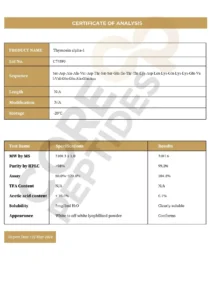
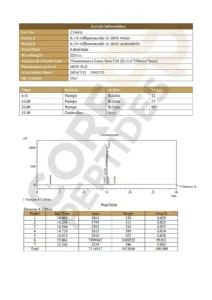
High-Performance Liquid Chromatography (HPLC): This test measures structural purity. The chromatogram should show a distinct, solitary peak confirming the absence of unwanted residual peptides.
-
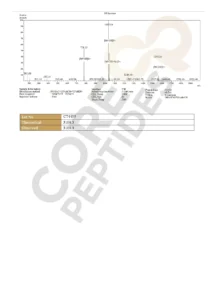
Mass Spectrometry (MS): This verifies identity. The MS profile must return an exact mass reading matching the molecular weight of 3108.3 g/mol.
-
Endotoxin Testing: High endotoxin levels can trigger unintended inflammatory responses in cell cultures or animal tissues, completely invalidating experimental results. Ensure your batch is verified as low-endotoxin or endotoxin-free [verify with brand/source].
How to Evaluate This thymosin alpha 1 Before Buying
When you are ready to buy thymosin alpha 1, navigate past generic product descriptions by verifying the following structural details with the vendor:
Step 1: Request Batch-Specific Documentation
Never rely on a generic, outdated Certificate of Analysis (COA). Request a modern, third-party lab-tested COA tied directly to the specific batch number on your vial.
Step 2: Evaluate the Sourcing and Logistics
Peptides are structurally delicate. Ask your supplier if they transport and pack their materials using temperature-regulated protocols. Exposure to extreme heat during transit can destabilize the 28-amino acid structure.
Step 3: Check Product Labeling
Reputable biochemical vendors clearly state that the material is designated for in vitro or in vivo laboratory research only. Avoid companies that market peptides with dosing protocols for human conditions, as this indicates a non-compliant workflow.
Thymosin alpha 1. Storage, Handling, and Usage Considerations
Maintaining the stability of your TA1 peptide is essential for securing consistent results over long-term research windows.
| Storage Phase | Optimum Temperature | Expected Stability |
| Lyophilized Powder (Sealed Vials) | $-20^\circ\text{C}$ to $-80^\circ\text{C}$ | Up to 24 months [verify with brand/source] |
| Lyophilized Powder (Short-Term) | $2^\circ\text{C}$ to $8^\circ\text{C}$ | 1 to 3 months [verify with brand/source] |
| Reconstituted Solution (Liquid) | $2^\circ\text{C}$ to $8^\circ\text{C}$ | Use within 7 days |
| Reconstituted Solution (Frozen) | $-20^\circ\text{C}$ | Up to 3 months (Single-use aliquots) |
Reconstitution Protocol for Lab Assays
-
Acclimatize: Let the lyophilized vial come completely to room temperature before opening to avoid ambient humidity condensation inside the glass.
-
Solvent Selection: Use sterile bacteriostatic water or standard sterile laboratory saline.
-
Introduction: Slowly trickle the liquid down the inner wall of the glass vial.
-
Dissolution: Gently swirl the fluid. Never shake the vial violently. Aggressive agitation can shear the delicate secondary structure of long-chain peptides.
Expert Insight: The Length-Stability Correlation
Pro Tip: Unlike tiny peptides (such as tripeptides or quadpeptides) that tolerate environmental fluctuations well, a 28-amino acid sequence like thymosin alpha 1 is far more vulnerable to enzymatic degradation and physical breakdown once in a liquid state. If your research assay requires a small daily volume over several weeks, you should always split the liquid into single-use micro-aliquots immediately after reconstitution. Freezing and thawing the entire vial multiple times will cause rapid structural fragmentation.
Why Choose CorePeptidesOfficial.com?
CorePeptidesOfficial.com provides professional-grade chemical compounds built for exact science.
-
Verified High Purity: We supply thymosin alpha 1 at a verified purity level of 98% or higher, eliminating background noise in your data [verify with brand/source].
-
Secure Vacuum Sealing: Our 5mg and 10mg vials are vacuum-packed and capped with chemical-resistant stoppers to keep out moisture and oxygen.
-
Traceable Analytics: Every order is fully trackable by batch number, matching our verified laboratory third-party data repository [verify with brand/source].
Common Mistakes to Avoid
-
Confusing Thymosin Alpha 1 with Thymosin Beta 4: These are entirely different peptides with unique structures and physiological targets. Double-check your experiment protocols to make sure you are purchasing the alpha variant.
-
Utilizing Non-Sterile Solvents: Reconstituting with unverified water sources introduces bacteria that secrete peptidases, ruining your sample within hours.
-
Relying on “Bodybuilding” or Wellness Forums for Lab Setup: Open-web forums often outline non-scientific handling methodologies. Rely strictly on peer-reviewed academic standards when setting up your lab assays.
Final Buying Guidance
Thymosin Alpha 1 is a reliable, high-performing asset for cellular signaling and immune pathway research. Before completing your checkout at CorePeptidesOfficial.com:
-
Select the vial configuration (5mg or 10mg) that minimizes leftover volume after reconstitution.
-
Verify your facility’s cold storage is calibrated to at least $-20^\circ\text{C}$.
-
Ensure your laboratory account credentials are current to speed up documentation tracking.
Are you preparing a new phase of comparative cell culture or animal modeling studies?
Frequently ask questions
What is the exact difference between Thymosin Alpha 1 and Thymosin Beta 4?
They have distinct chemical structures and biological jobs. Thymosin Alpha 1 (28 amino acids) works primarily as an immune modulator tracking cell signaling and T-cell development. Thymosin Beta 4 (43 amino acids) acts primarily as an actin-sequestering peptide that regulates cell migration and tissue repair.
What is the molecular weight of the TA1 peptide?
The exact molecular weight of synthetic thymosin alpha 1 is 3108.3 g/mol.
Can this peptide be stored at room temperature?
Only for brief periods during shipping (lyophilized state). For long-term preservation, the un-reconstituted powder must be kept in a freezer at $-20^\circ\text{C}$ or below to prevent slow degradation.
What are the side effects of thymosin alpha 1 in laboratory animals?
In peer-reviewed animal models, recorded side effects are minimal but can include local tissue irritation at the injection site or mild shifts in baseline body temperature due to immune system activation [verify with source].
Is thymosin alpha 1 an approved supplement?
No. Synthetic thymosin alpha 1 sold online is not a dietary supplement, nor is it approved by the FDA for human use, treatment, or disease prevention. It is legally categorized as a research chemical.
| Size | 10mg, 5mg |
|---|
Certificate of Analysis
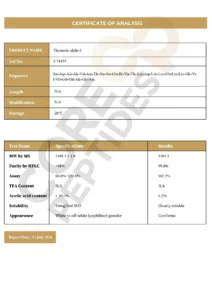
HPLC
Mass Spectrometry
Be the first to review “Thymosin Alpha-1 ( 5mg / 10mg )”
Related products
Peptides
Peptides
Reviews
There are no reviews yet.