

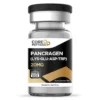

Palmitoyl Tetrapeptide-7 Buying Guide: Quality, Science, and Verification
If you are looking to buy Palmitoyl Tetrapeptide-7 (200mg) online, ensuring chemical integrity and source reliability is paramount. Palmitoyl Tetrapeptide-7 is a highly sought-after synthetic peptide widely utilized in laboratory research, in vitro cellular studies, and biochemical assays. Because its applications focus on cellular signaling, down-regulating inflammatory markers, and extracellular matrix synthesis, researchers require high-purity compounds to yield reproducible data.
This comprehensive guide covers everything you need to know before securing this peptide for your laboratory.
Product Highlights & Quick Facts
-
Product Type: Synthetic Messenger Peptide (Matrikine class)
-
Format: Lyophilized (freeze-dried) white powder
-
Mass Content: 200mg per vial
-
Target Purity: $\ge$ 98% (verified via HPLC and Mass Spectrometry) [verify with brand/source]
-
Primary Application: In vitro laboratory research and biochemical analysis
-
Storage Requirements: Store at -20°C for long-term stability; avoid moisture and light
-
Best-Fit Buyer: Qualified laboratory researchers, clinical biochemists, and institutional buyers
What is Palmitoyl Tetrapeptide-7?
Palmitoyl Tetrapeptide-7 is a synthetic peptide consisting of four amino acids linked to palmitic acid. The addition of palmitic acid—a fatty acid—enhances the lipophilicity of the molecule, allowing for better cell membrane permeability in experimental models.
Classified as a matrikine, this peptide mimics natural breakdown fragments of the extracellular matrix. In biological systems, it acts as a cellular messenger. It primarily works by signaling cells to reduce the production of interleukin-6 (IL-6), a key pro-inflammatory cytokine. In research environments, it is frequently studied alongside palmitoyl tripeptide-1 to observe synergistic effects on cellular rejuvenation, tissue remodeling, and collagen production.
Key Research Use Cases and Benefits
In laboratory settings, researchers study palmitoyl tripeptide 1 and palmitoyl tetrapeptide 7 to observe how cells respond to matrix signaling. Key areas of investigation include:
-
Inflammatory Modulation: Investigating how the compound suppresses overactive immune signals (like IL-6) in skin cell models exposed to UV radiation or chemical stressors.
-
Extracellular Matrix (ECM) Synthesis: Analyzing the rate at which fibroblasts generate collagen, elastin, and hyaluronic acid when introduced to the peptide.
-
Synergistic Blends: Exploring how a matrix combo of palmitoyl tripeptide 1 and palmitoyl tetrapeptide 7 optimizes structural integrity compared to single-peptide protocols.
Quality, Purity, and Testing Standards
In the research chemical industry, analytical verification separates professional suppliers from unreliable sources. Low-quality peptides introduce artifacts, contaminants, and degradation products that can ruin weeks of experimental data.
Every batch of Palmitoyl Tetrapeptide-7 must undergo a rigorous two-step testing protocol:
-
High-Performance Liquid Chromatography (HPLC): Confirms the purity level of the peptide. Look for batches demonstrating $\ge$ 98% purity to ensure negligible impurities.
-
Mass Spectrometry (MS): Confirms the exact molecular weight and chemical identity of the peptide, ensuring you are receiving genuine Palmitoyl Tetrapeptide-7 and not a substituted sequence.
How to Evaluate This Product Before Buying
Before completing your checkout, run through this verification checklist to guarantee a safe, compliant transaction:
1. Request the Certificate of Analysis (COA)
Never buy from a vendor that hides its third-party testing. A valid COA should match the current batch number on your vial and clearly show the date of testing, the testing laboratory, and the raw HPLC/MS charts.
2. Verify Labeling Clarity
Compliant research chemicals must be clearly labeled with their exact mass (e.g., 200mg), chemical name, and an explicit statement indicating “For Research Use Only.”
3. Check Shipping Countermeasures
Peptides are temperature-sensitive. Ensure the vendor uses temperature-controlled processing, vacuum-sealing, and protective packaging to safeguard the lyophilized cake during transit.
Storage, Handling, and Usage Considerations
Proper preservation preserves peptide viability and prevents premature degradation.
-
Arrival & Lyophilized State: Upon delivery, keep the vials in their freeze-dried state. Store them in a standard refrigerator (2°C to 8°C) for short-term storage (under 3 months) or a deep freezer (-20°C to -80°C) for long-term storage (up to several years).
-
Reconstitution Protocol: When preparing for an assay, allow the vial to reach room temperature before introducing a sterile bacteriostatic or laboratory-grade solvent. This prevents condensation inside the vial.
-
Post-Reconstitution: Once reconstituted, liquid peptides are highly fragile. Store them at 2°C to 8°C and use within the recommended window [verify with brand/source]. Avoid vigorous shaking; gently swirl the vial to mix.
💡 Expert Insight / Pro Tip
When working with palmitoyl tripeptide-1 & palmitoyl tetrapeptide-7 combinations in comparative studies, always reconstitute each peptide separately first. This allows you to precisely control individual molar concentrations before creating your experimental blends, preventing uneven dissolution.
Why Choose CorePeptidesOfficial.com?
At CorePeptidesOfficial.com, we prioritize transparency, batch consistency, and rigorous logistics. We understand that your research hinges on the exactness of your compounds.
-
Transparent Sourcing: Every batch undergoes independent third-party laboratory verification.
-
Secured Purity: Our Palmitoyl Tetrapeptide-7 (200mg) vials are filled using precise lyophilization tech to lock in maximum stability.
-
Dedicated Support: Our team provides comprehensive batch tracking and easy access to corresponding COAs.
Common Mistakes to Avoid
-
Buying Based on Price Alone: Cheap peptides often contain residual trifluoroacetic acid (TFA), heavy metals, or structural isomers that distort biological results.
-
Ignoring Temperature Fluctuations: Leaving vials sitting in warm receiving docks or subjected to repeated freeze-thaw cycles will denature the peptide sequence.
-
Assuming Clinical Readiness: Palmitoyl Tetrapeptide-7 sold in pure 200mg formats is designed strictly for laboratory evaluation, not direct human application or cosmetic mixing at home.
Final Buying Guidance
Securing your lab supplies should be seamless and low-risk. When preparing to buy Palmitoyl Tetrapeptide-7 (200mg) online, verify your quantity requirements, confirm that your laboratory has the appropriate storage capabilities (-20°C), and double-check the batch verification files.
Ready to advance your cellular matrix research? Review our verified batch analytics and secure your allocation today.
[Explore Palmitoyl Tetrapeptide-7 (200mg) at CorePeptidesOfficial.com]
Frequently Asked Questions
- What is the difference between Palmitoyl Tetrapeptide-7 and Palmitoyl Tripeptide-1? Palmitoyl Tetrapeptide-7 features a four-amino-acid chain and primarily targets cellular pathways associated with inflammatory responses (like IL-6). Palmitoyl Tripeptide-1 features a three-amino-acid chain and focuses predominantly on stimulating collagen and matrix repair mechanisms. They are frequently used together to evaluate compound synergy.
- How should the 200mg lyophilized powder be stored upon arrival? Keep the vial sealed and store it in a freezer at -20°C. This protects the peptide bonds from moisture degradation and maintains chemical stability for long-term storage.
- Can I get a copy of the Certificate of Analysis (COA) for my batch? Yes. CorePeptidesOfficial.com provides batch-specific COAs detailing HPLC purity profiles and mass spectrometry identification upon request or checkout [verify with brand/source].
- What solvents are typically used to reconstitute this peptide? Researchers typically use sterile bacteriostatic water, sterile normal saline, or laboratory-grade buffers depending on the specific requirements of their cellular assay protocol.
- Is this product safe for human consumption or cosmetic formulation? No. This product is a high-concentration raw chemical supplied exclusively for in vitro, laboratory, and institutional research purposes. It is not approved for direct human consumption, medical use, or therapeutic applications.
Be the first to review “Palmitoyl Tetrapeptide -7 (200mg)”
Related products
Peptides
Peptides
Peptides
Reviews
There are no reviews yet.