

Buy Pal-GHK (200mg) Online: The Researcher’s Guide to Palmitoyl Tripeptide-1
If you are looking to buy Pal-GHK (200mg) online, navigating the sea of research chemical suppliers can be challenging. Pal-GHK (also known as Palmitoyl Tripeptide-1 or Palmitoyl Oligopeptide) is one of the most widely researched peptides in cosmetic science, cellular biology, and tissue regeneration studies.
This guide provides clear, transparent, and verified technical information to help you evaluate product quality, review testing standards, and make an informed decision for your laboratory’s needs.
Quick Facts & Product Highlights
-
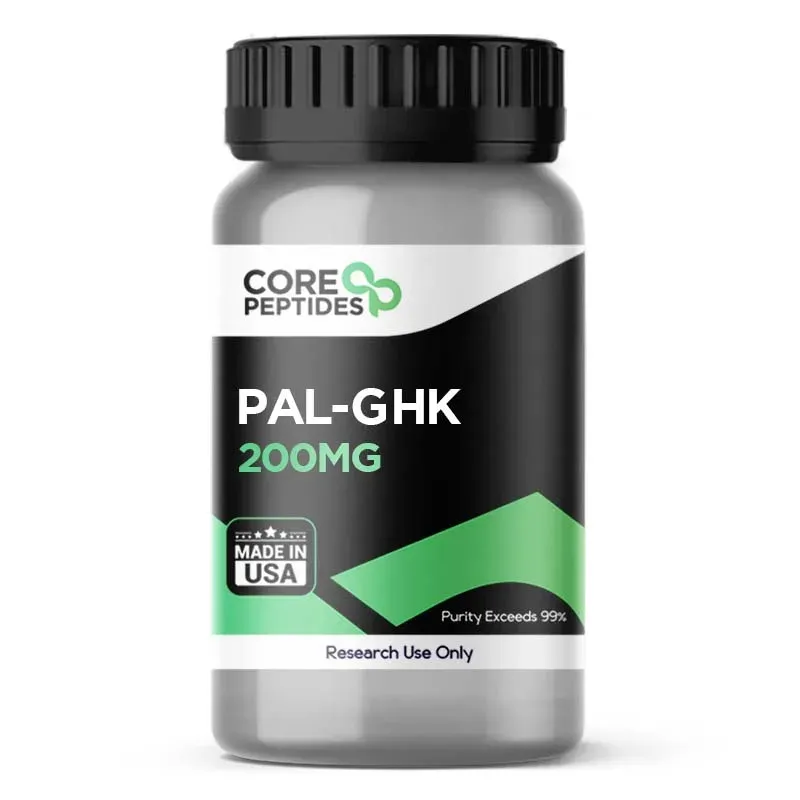
Product Name: Pal-GHK (Palmitoyl Tripeptide-1)
-
Format: Lyophilized (freeze-dried) white powder
-
Vial Size: 200mg [verify with brand/source]
-
Purity Standard: Greater than 99% (verified via HPLC)
-
Intended Use: In vitro laboratory research and development only (not for human consumption)
-
Optimal Storage: Lyophilized powder is stable at room temperature for short periods, but long-term storage should be at -20°C.
-
Best-Fit Buyer: Academic researchers, formulation chemists, and biotech laboratories.
What is Pal-GHK?
Pal-GHK is a synthetic lipopeptide. It is created by attaching a palmitic acid (a fatty acid) to the classic messenger peptide GHK (Glycyl-Histidyl-Lysine).
[Palmitic Acid (C16)] ---> Attached to ---> [GHK Peptide (Gly-His-Lys)]
The addition of the palmitic acid chain is a critical design feature. While the base peptide GHK is highly hydrophilic (water-loving), it struggles to pass through lipophilic (fat-friendly) barriers on its own. By attaching palmitic acid, the molecule’s lipophilicity increases. This modification allows the peptide to interact much more effectively with lipid bilayers in laboratory models, enhancing its overall stability and cellular uptake during testing.
Key Research Use Cases & Benefits
In scientific literature, Pal-GHK is primarily investigated for its role as a matrikine—a messenger peptide that signals cells to repair and rebuild the extracellular matrix (the structural network supporting cells).
1. Extracellular Matrix Synthesis
Research suggests that Pal-GHK acts as a biological signal to fibroblasts (the cells responsible for producing connective tissue). Studies focus on its ability to stimulate the synthesis of:
-
Collagen Type I and III: The structural scaffolding of tissue.
-
Elastin: The protein responsible for tissue elasticity.
-
Glycosaminoglycans (GAGs): Compounds like hyaluronic acid that retain moisture.
2. Tissue Repair and Wound Healing Models
Because it mimics natural breakdown fragments of collagen, Pal-GHK is widely used in models studying localized tissue repair. Researchers analyze how the peptide “tricks” cellular systems into thinking structural proteins have degraded, thereby triggering a natural, localized healing cascade.
3. Structural Integrity and Moisture Retention
By encouraging the upregulation of structural proteins, laboratory assays show that Pal-GHK helps support the structural density of cell matrices, leading to better moisture retention and overall barrier resilience.
Quality, Purity, and Testing Standards
When you purchase research peptides online, purity is the single most important factor. Low-purity peptides contain residual reagents, trifluoroacetic acid (TFA) salts, or truncated peptide sequences that can ruin your experimental results.
At CorePeptidesOfficial.com, every batch of Pal-GHK (200mg) undergoes rigorous quality control to ensure reproducibility in your assays:
-
High-Performance Liquid Chromatography (HPLC): This analytical technique separates the components of the sample to confirm that the target peptide, Pal-GHK, meets a minimum purity threshold of 99%.
-
Mass Spectrometry (MS): This test measures the mass-to-charge ratio of the molecules, confirming the exact molecular weight of Pal-GHK to verify that the peptide sequence is correct.
-
Lyophilization: The peptide is freeze-dried under sterile conditions to eliminate moisture, which prevents degradation and ensures a long shelf-life prior to reconstitution.
How to Evaluate Pal-GHK Before Buying
Before completing your purchase, use this verification checklist to ensure you are receiving a premium research-grade product:
| Verification Step | What to Look For | Why it Matters |
| Certificate of Analysis (COA) | A clean, downloadable PDF matching your current batch. | Confirms the purity and identity of the exact vial you receive. |
| Purity Percentage | A score of $\ge 99\%$ on the HPLC chromatogram. | Ensures no interfering chemical contaminants exist in your sample. |
| Vial Seals | Pristine, flip-off aluminum caps with a secure rubber stopper. | Prevents moisture ingress and oxidation during transport. |
| Intended Use Labeling | Clear “For Research Use Only” (RUO) markings. | Protects your laboratory compliance and safety protocols. |
Storage and Handling Considerations
To preserve the bioactivity of your Pal-GHK (200mg) vials, strict storage protocols must be maintained.
Before Reconstitution (Lyophilized Powder)
-
Short-term storage (under 3 months): Store in a standard refrigerator at 2°C to 8°C.
-
Long-term storage (over 3 months): Store in a manual defrost freezer at -20°C or lower. Avoid auto-defrost freezers, as temperature fluctuations can degrade the peptide structure over time.
After Reconstitution (Liquid Phase)
-
Solvent Selection: Pal-GHK’s attached palmitic acid chain makes it highly hydrophobic compared to standard GHK. While it may dissolve in sterile water, researchers often use a mild organic solvent like Dimethyl Sulfoxide (DMSO) [verify with brand/source] or a buffer solution to ensure complete solubilization.
-
Temperature: Keep reconstituted solutions at 2°C to 8°C.
-
Shelf-life: Use reconstituted solutions within 4 to 8 weeks. Do not freeze and thaw liquid solutions repeatedly, as this shears the peptide bonds.
Pro Tip: The Lipophilic Difference
Remember that Pal-GHK behaves differently than GHK-Cu or standard GHK-basic in solution. Because of the palmitoyl tail, it acts more like a surfactant. When reconstituting, add your sterile diluent slowly down the side of the vial. Do not shake the vial vigorously, as this will cause excessive foaming and may damage the peptide. Instead, gently swirl the vial until the powder is fully dissolved.
Why Choose CorePeptidesOfficial.com?
Purchasing from a reliable supplier protects your research budget and your data’s credibility.
-
Verified Batch Integrity: We do not rely on outdated, static COAs. Our testing is batch-specific, meaning the documentation matches the physical product delivered to your bench.
-
Secure Cold-Chain Ready Packaging: We ship our lyophilized peptides in highly insulated packaging to protect them from heat spikes during transit.
-
Dedicated Research Support: Our support team understands the science. If you need help verifying a batch number or accessing a COA, we are ready to assist.
Common Mistakes to Avoid
-
Conflating GHK with Pal-GHK: GHK is highly hydrophilic and dissolves easily in water. Pal-GHK requires careful solvent planning due to its lipid tail. Ensure your protocol is designed specifically for the palmitoylated form.
-
Using Auto-Defrost Freezers: These freezers cyclically warm up to melt frost, exposing your lyophilized peptide to repeated freeze-thaw micro-cycles that reduce shelf-life.
-
Vigorous Shaking: Shaking the vial can break delicate peptide structures and create persistent foam that makes accurate pipetting impossible.
Final Buying Guidance
Pal-GHK is an essential tool for research studying cellular matrix communication, tissue repair pathways, and topical formulation chemistry. To ensure your research yields accurate, reproducible data, always prioritize 99%+ purity verified by independent HPLC testing.
If you are ready to secure high-grade Pal-GHK (200mg) for your upcoming assays, check the current batch test results and place your order securely.
Frequently Asked Questions
- What is the difference between GHK and Pal-GHK? Standard GHK is a highly water-soluble copper-binding peptide. Pal-GHK has a palmitic fatty acid chain attached to it, which increases its fat solubility (lipophilicity). This allows Pal-GHK to penetrate lipid barriers more effectively in cellular models.
- How should I reconstitute Pal-GHK (200mg)? Due to its lipophilic palmitoyl chain, dissolving Pal-GHK can be more challenging than standard peptides. While water is sometimes sufficient, many researchers use a small amount of DMSO or a specific buffer solution to achieve complete dissolution without foaming.
- Is Pal-GHK safe for human consumption? No. Pal-GHK sold by CorePeptidesOfficial.com is strictly for in vitro laboratory research, diagnostic testing, and formulation development. It is not approved for human or veterinary use, consumption, or direct topical application outside of controlled research models.
- How long does a lyophilized vial of Pal-GHK last? When stored properly in a sealed vial at -20°C, lyophilized Pal-GHK powder remains stable for up to 24 months. At room temperature, it can remain stable for several weeks, though cold storage is always recommended to prevent degradation.
- Where can I find the Certificate of Analysis (COA) for my purchase? Every batch of Pal-GHK has a corresponding COA verifying its purity and identity via HPLC/MS. You can download this directly from our verification portal using your specific batch number, or contact our support team to have it sent directly to your lab.
Be the first to review “Pal-GHK (200mg)”
Related products
Peptides
Peptides
Reviews
There are no reviews yet.