
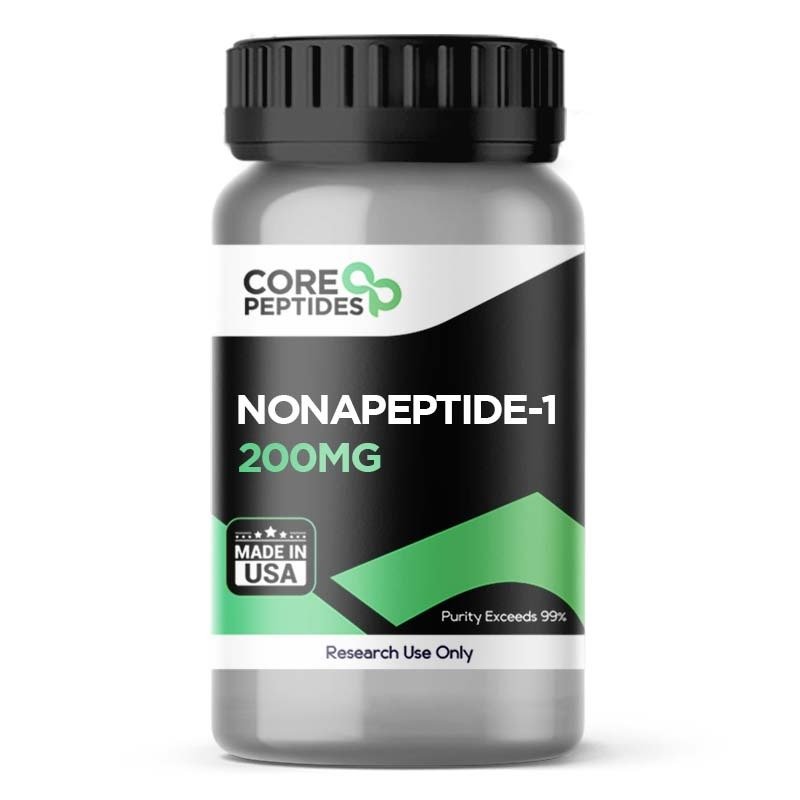
Buy Nonapeptide-1 (200mg) Online: The Definitive Buyer’s Guide
If you are looking to buy Nonapeptide-1 (200mg) online, navigating the research chemical market requires a strict eye for quality, transparency, and analytical verification. Nonapeptide-1 is heavily studied in biochemical and dermatological research for its role in melanin synthesis pathways. Because it is a highly specialized compound, sourcing it requires more than just finding the lowest price—it demands verifiable purity.
This comprehensive guide breaks down what Nonapeptide-1 is, how it functions in a laboratory setting, and how to safely evaluate your options before completing your purchase.
Product Highlights & Quick Facts
-
Product Type: Synthetic Peptide
-
Target Sequence: Met-Pro-D-Phe-Arg-D-Trp-Phe-Lys-Pro-Val (melanocyte-stimulating hormone antagonist) [verify with brand/source]
-
Format: Lyophilized (freeze-dried) white powder
-
Mass / Quantity: 200mg per vial
-
Purity Rating: Greater than or equal to 98% (verified via HPLC/MS) [verify with brand/source]
-
Intended Use: In vitro and in vivo laboratory research only; not for human consumption or cosmetic formulation
-
Primary Storage: Temperature-controlled, dry environment (-20°C preferred for long-term stability)
-
Best-Fit Buyer: Independent biochemistry researchers, academic laboratories, and biotech procurement officers
What Is Nonapeptide-1?
Nonapeptide-1 is a synthetic peptide made up of nine amino acids. In scientific literature, it is classified as an antagonist of the melanocortin-1 receptor (MC1R).
Under normal physiological conditions, a hormone called Alpha-MSH (Alpha-Melanocyte-Stimulating Hormone) binds to the MC1R receptor. This binding triggers a cascade that tells cells called melanocytes to produce melanin, the pigment responsible for skin color. Nonapeptide-1 works by physically blocking this receptor site. By preventing Alpha-MSH from binding to MC1R, it interrupts the signal that initiates pigment production.
Research Context: Because it targets the very beginning of the hyperpigmentation pathway, researchers study this peptide to understand the mechanisms behind age spots, melasma, and uneven skin tone.
Key Benefits and Areas of Research
While commercial skincare products use lower concentrations of this peptide for cosmetic brightening, high-mass variants like Nonapeptide-1 (200mg) are specifically produced for rigorous experimental models. Researchers utilize this compound to explore several key cellular behaviors:
-
Melanogenesis Inhibition: Investigating how effectively the peptide downregulates tyrosinase activity (the enzyme needed to create melanin) in cell cultures.
-
Inflammatory Pigmentation Pathways: Analyzing whether blocking MC1R can prevent dark spots caused by ultraviolet (UV) radiation or inflammatory triggers.
-
Synergistic Peptide Interactions: Testing Nonapeptide-1 alongside other compounds, such as copper peptides or vitamin C derivatives, to observe compounding biochemical effects.
Quality, Purity, and Testing Standards
In the research chemical industry, a label is only as good as the laboratory report backing it up. Unverified peptides often contain residual solvents, heavy metals, or truncated peptide sequences (broken fragments of the chain) that can completely skew your experimental data.
When purchasing Nonapeptide-1, you should look for two essential analytical tests:
-
High-Performance Liquid Chromatography (HPLC): This test separates the components of the sample to measure exact purity. Top-tier research suppliers look for a clean, single peak representing a purity profile of 98% or higher.
-
Mass Spectrometry (MS): While HPLC shows how pure the sample is, MS confirms its identity by calculating its precise molecular weight. This ensures you are actually receiving Nonapeptide-1 rather than a different peptide sequence.
How to Evaluate This Product Before Buying
Before clicking “add to cart” on any site offering Nonapeptide-1 (200mg) for sale, run through this verification checklist to ensure you are buying from a reputable vendor:
-
Check for Batch-Specific COAs: A Certificate of Analysis (COA) should not be a static image from three years ago. Ensure the vendor offers current, third-party lab testing linked directly to the lot or batch number on your vial.
-
Analyze the Packaging: Peptides are delicate. They should arrive in sealed, sterile glass vials with flip-off aluminum caps to protect the vacuum seal.
-
Look for Clear Disclaimers: Trustworthy suppliers are highly transparent about compliance. The product must explicitly state that it is for laboratory research use only. Avoid companies that market research chemicals with dosing instructions or human health claims.
Storage and Handling Considerations
Proper handling is critical to preserving the molecular integrity of your 200mg Nonapeptide-1 sample:
-
Upon Arrival: Keep the lyophilized powder in its original sealed vial. Store it in a standard refrigerator (2°C to 8°C) if you plan to use it within a few weeks. For long-term storage, keep it in a freezer at -20°C to prevent degradation.
-
Reconstitution: When you are ready to prepare the peptide for testing, use a sterile bacteriostatic water or sterile saline solution [verify with brand/source]. Gently roll the vial between your palms to dissolve the powder. Never shake the vial vigorously, as violent agitation can break the delicate peptide bonds and ruin the sample.
-
Post-Reconstitution Storage: Once liquid is added, the peptide becomes significantly less stable. Keep it refrigerated and use it within the timeframe recommended by the analytical datasheet [verify with brand/source].
Expert Insight: Minimizing Experimental Drift
Pro Tip: Temperature fluctuations during transit can induce subtle structural degradation in peptides. When purchasing a large 200mg mass of Nonapeptide-1, opt for suppliers that utilize temperature-shielded shipping materials. Once reconstituted, divide your solution into smaller working aliquots (single-use portions) rather than repeatedly freezing and thawing the master vial. Repeated freeze-thaw cycles fracture the peptide structure and alter concentration accuracy.
Why Choose CorePeptidesOfficial.com?
At CorePeptidesOfficial.com, we recognize that reliable research requires reliable materials. We do not cut corners, mask data, or hide behind vague claims.
Our Nonapeptide-1 (200mg) samples are manufactured using strict solid-phase peptide synthesis protocols. Every single batch undergoes third-party verification to guarantee that identity and purity levels meet or exceed standard laboratory benchmarks. We pair our products with transparent customer support, secure shipping, and fully accessible batch analytics so you can focus entirely on your data—not on vetting your supplier.
Common Mistakes to Avoid
-
Buying Liquid Nonapeptide-1 Online: If a supplier sells Nonapeptide-1 pre-mixed in a liquid solution for research purposes, be highly cautious. Peptides break down quickly in water. True research-grade peptides should almost always be purchased as a dry, lyophilized powder.
-
Ignoring the Mass-to-Volume Ratio: A 200mg vial contains a substantial amount of active peptide. Ensure your laboratory calculations accurately reflect this high mass when determining your reconstitution volumes.
-
Assuming Cross-Vendor Consistency: Never assume that a sequence from one supplier behaves identically to another without checking the COA. Subtle differences in counter-ions or salts left over from synthesis can alter solubility.
Final Buying Guidance
Sourcing Nonapeptide-1 (200mg) safely requires a commitment to quality control. By prioritizing third-party tested, lyophilized powders and avoiding vendors making unsupported health claims, you protect both your budget and your research integrity.
When you are ready to purchase, ensure your lab is equipped for proper cold storage and careful reconstitution. Explore the fully verified batches available on CorePeptidesOfficial.com to secure dependable, high-purity compounds for your next project.
Frequently Asked Questions
- What is the exact molecular weight of Nonapeptide-1? The molecular weight typically sits around 1200 to 1300 g/mol, depending on the exact salt form used during synthesis [verify with brand/source]. You can find the exact mass for your specific batch on the provided Mass Spectrometry report.
- Why does Nonapeptide-1 come in a 200mg mass instead of smaller 5mg vials? While smaller vials are common for exploratory testing, a 200mg mass is designed for high-throughput screening, larger-scale cell culture studies, or longitudinal research where batch consistency across multiple tests is critical.
- Can I use tap or purified drinking water to dissolve the powder? No. Tap water and regular purified water contain microscopic minerals and impurities that can degrade the peptide or cause bacterial growth. Only use sterile, laboratory-grade bacteriostatic or sterile water.
- How do I know if my batch of Nonapeptide-1 is authentic? Every vial purchased from a reputable supplier should feature a batch or lot number. You can match this number to the online HPLC and MS data sheets to verify the purity percentage and molecular structure.
- Is Nonapeptide-1 safe for human clinical trials? The Nonapeptide-1 sold here is strictly designated for in vitro (cell culture) and laboratory research applications. It is not approved for human clinical ingestion, injection, or topical applications.
Be the first to review “Nonapeptide-1 (200mg)”
Related products
Peptides
Peptides
Reviews
There are no reviews yet.