
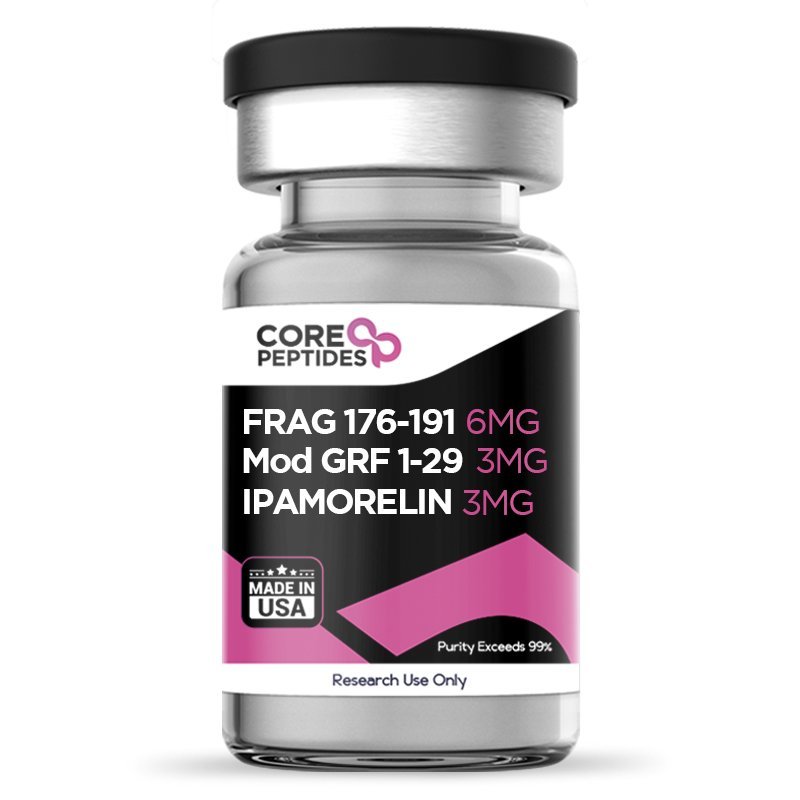
Fragment 176-191 & Mod GRF 1-29 & Ipamorelin Blend: The Researcher’s Guide
If you are looking to purchase a Fragment 176-191 & Mod GRF 1-29 & Ipamorelin Blend online, you likely already know how complex the peptide market can be. Finding consistent, high-purity multi-peptide formulations requires careful vetting. This guide breaks down exactly what this 12mg blend is, how its components function in a laboratory setting, and how to verify quality before making a purchase.
Product Highlights & Quick Facts
-
Product Type: Multi-peptide trifecta blend
-
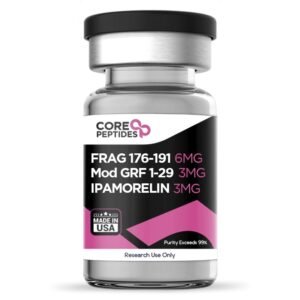
Total Mass: 12mg per vial (typically ratioed as [verify ratio, e.g., 6mg / 3mg / 3mg] per component—verify with brand)
-
Format: Lyophilized (freeze-dried) white powder/cake
-
Purity Standard: Greater than 98% (verified via third-party HPLC and MS testing)
-
Primary Intended Use: In vitro laboratory research and professional analytical studies
-
Storage Requirements: Store at -20°C for long-term stability; refrigerate at 2°C to 8°C for short-term use
-
Best-Fit Buyer: Laboratory researchers, biotech institutional buyers, and credentialed life sciences analysts
What the Product Is
The Fragment 176-191 & Mod GRF 1-29 & Ipamorelin Blend is a highly specialized, pre-mixed formulation of three distinct synthetic peptides. Instead of managing three separate vials, researchers use this combination to observe the overlapping pathways of Growth Hormone Secretagogues (GHS) and isolated lipolytic fragments simultaneously.
The blend is manufactured as a sterile, lyophilized cake inside a glass vial. Lyophilization is a freeze-drying process that removes moisture to preserve the structural integrity of the delicate peptide bonds during shipping and storage.
+-------------------------------------------------------------------------+
|                  12mg Multi-Peptide Blend Architecture                  |
+----------------------------------+--------------------------------------+
| Fragment 176-191                 | C-terminal fragment of GH targeting  |
| (Lipolytic Fragment)             | adipocyte pathways specifically.     |
+----------------------------------+--------------------------------------+
| Modified GRF 1-29                | GHRH mimetic that acts as an agonist |
| (Sermorelin Analog)              | at pituitary receptors.              |
+----------------------------------+--------------------------------------+
| Ipamorelin                       | Selective GHSR agonist that avoids   |
| (Ghrelin Mimetic)                | cortisol or prolactin spikes.        |
+----------------------------------+--------------------------------------+
The Core Components Explained
To evaluate this blend accurately, you must understand how its three constituent parts operate at a cellular level in test models.
- Fragment 176-191 (The Lipolytic Segment); This peptide is a small piece of the larger human growth hormone (hGH) chain—specifically, the amino acids from position 176 to 191 at the C-terminus. In laboratory settings, researchers study this fragment because it isolates the fat-metabolizing (lipolytic) characteristics of hGH. Crucially, it does this without triggering the insulin-like growth factor-1 (IGF-1) spikes or glycemic disruptions associated with the full-length hormone.
- Mod GRF 1-29 (Modified Growth Releasing Factor); Also known as tetrasubstituted CJC-1295 without DAC, Mod GRF 1-29 is a synthetic analog of endogenous Growth Hormone-Releasing Hormone (GHRH). By modifying four specific amino acids in the standard 1-29 chain, scientists created a molecule with significantly higher stability in blood plasma than natural GHRH. In vitro, it binds to pituitary receptors to stimulate pulsatile hormone secretion.
- Ipamorelin; Ipamorelin is a pentapeptide and a highly selective agonist of the ghrelin/growth hormone secretagogue receptor (GHSR). Unlike older secretagogues, Ipamorelin is unique because it does not stimulate the production of unwanted secondary hormones like cortisol (the stress hormone) or prolactin. It works synergistically alongside Mod GRF 1-29 by targeting a completely different receptor pathway to achieve a synchronized response.
Quality, Purity, and Testing Standards
In the research chemical industry, visual appearance means very little. A white powder can contain heavy metals, residual solvents, or incorrect peptide ratios while still looking perfectly clean. Genuine quality relies entirely on transparent, verifiable laboratory analytics.
The Gold Standard of Testing: High-purity peptides must undergo two primary tests before they are cleared for laboratory use: High-Performance Liquid Chromatography (HPLC) and Mass Spectrometry (MS).
-
HPLC (Purity Tracking): This technique separates the components of a mixture to identify any impurities, truncated sequences, or synthesis byproducts. Reputable vendors accept nothing less than 98% purity.
-
Mass Spectrometry (Identity Tracking): While HPLC shows how pure the sample is, MS confirms exactly what the sample is. It measures the precise molecular weight of the peptide chain to ensure the amino acid sequence matches the target design.
How to Evaluate This Product Before Buying
When sourcing a multi-peptide formulation like the Fragment 176-191 & Mod GRF 1-29 & Ipamorelin Blend, you must audit the vendor before clicking checkout. Use this clear checklist to verify quality:
-
Request an Exact Match Certificate of Analysis (COA): A reliable vendor provides public access to a COA for the specific batch you are purchasing. Check that the document comes from an independent, third-party domestic laboratory, rather than an internal lab sheet.
-
Inspect the Batch Identification Number: Every production run should have a dedicated batch number printed clearly on the vial label. This allows you to cross-reference your individual vial directly with the corresponding HPLC testing file.
-
Review Intended-Use Labels: The product label should clearly state “For Research Use Only” or “Not for Human Consumption.” Vendors using compliant, non-medical language show that they follow strict global biotech supply standards.
-
Assess Shipping Standards: Lyophilized peptides can tolerate short-term room temperatures during transit. However, check whether the vendor utilizes temperature-shielded packaging or expedited shipping options to prevent thermal degradation during hot summer months.
Storage, Handling, and Usage Considerations
Peptides are highly vulnerable to thermal damage and physical shear forces. Improper handling can quickly ruin an entire batch.
Before Reconstitution
Keep the lyophilized powder sealed in its original vial. For studies extending beyond 2 to 4 weeks, store the vial in a stable deep-freeze environment at -20°C. For immediate, short-term usage within a few weeks, standard refrigeration between 2°C and 8°C is sufficient. Protect the vial from direct sunlight and moisture exposure at all times.
During Reconstitution
When introducing a laboratory solvent—typically Bacteriostatic Water or sterile research-grade saline—never spray the liquid directly onto the lyophilized cake. Forceful impacts can cleave the fragile peptide links. Instead, angle the syringe needle against the inside glass wall of the vial, allowing the solvent to slide down gently.
Post-Reconstitution
Once liquid is introduced, the blend enters a highly unstable state. Do not shake the vial. Instead, slowly roll the vial between your palms until the powder completely dissolves. Store the reconstituted fluid strictly inside a dedicated refrigerator at 2°C to 8°C. Use the solution within [verify time window, e.g., 21 to 30 days] to prevent a natural drop in potency.
Expert Insight & Pro Tip
Analytical Focus: When tracking research metrics with this blend, pay close attention to the structural stability of Mod GRF 1-29 vs. Ipamorelin in your solution. Multi-peptide blends can experience slight variations in degradation rates between the individual components over time. To preserve an exact experimental baseline, avoid preparing more vials than your immediate weekly testing protocols require.
Why Choose CorePeptidesOfficial.com?
At CorePeptidesOfficial.com, we understand that erratic data kills research projects. We do not source mass-market, unvetted chemicals. Every batch of our Fragment 176-191 & Mod GRF 1-29 & Ipamorelin Blend (12mg) undergoes strict quality protocols to guarantee consistency across every single vial.
-
100% Transparent Batch Testing: Every vial is backed by up-to-date, independent third-party HPLC and MS analytics that you can review before buying.
-
Strict Synthesis Controls: Our manufacturing processes ensure that the 12mg total mass contains the exact, uncompromised ratio of all three peptides, preventing uneven saturation in your assays.
-
Secure, Protected Shipping: We pack our items using professional laboratory insulation to guarantee structural integrity from our facility to your lab bench.
Common Mistakes to Avoid
-
Buying Based Solely on Price: Low-cost blends are frequently under-dosed, padded with excess mannitol (a common bulking agent), or contain incomplete peptide fragments that lack cellular affinity.
-
Using Non-Sterile Solvents: Mixing the blend with basic distilled water instead of certified bacteriostatic water can introduce bacterial contamination, completely invalidating your research data.
-
Storing in Free-Frost Freezers: Avoid storing your lyophilized peptides in domestic, frost-free freezers. These appliances run regular temperature spikes to melt frost build-up, which can unknowingly degrade the structural bonds of your peptides.
Final Buying Guidance
Sourcing your Fragment 176-191 & Mod GRF 1-29 & Ipamorelin Blend should never feel like a gamble. By choosing high-purity, batch-verified 12mg vials, you protect the accuracy of your laboratory data and ensure reproducible results.
Before completing your purchase, double-check your current laboratory supply of reconstitution solvents, verify the availability of the batch COA, and confirm that your storage equipment is calibrated to the correct temperature settings.
Frequently Asked Questions
- What does the “12mg” measurement signify in this blend? The 12mg measurement indicates the total combined net mass of all three lyophilized peptides contained within the single vial. It does not include the weight of the protective glass vial or any sterile bulking agents used during the freeze-drying process.
- Can I store reconstituted peptides in the freezer? No. Freezing a peptide after it has been mixed with a liquid solvent will create sharp ice crystals that can tear the peptide strands apart, destroying their effectiveness. Keep reconstituted solutions refrigerated between 2°C and 8°C.
- What is the difference between Mod GRF 1-29 and CJC-1295 with DAC? Mod GRF 1-29 is often referred to as “CJC-1295 without DAC.” It acts as a short, clean pulse of GHRH because it lacks the Drug Affinity Complex (DAC). CJC-1295 with DAC binds heavily to blood proteins, extending its activity window artificially for days, which alters natural pulsatile cycles.
- Why are these three specific peptides blended together? They are combined to evaluate overlapping biological pathways simultaneously. Fragment 176-191 acts solely on lipid target sites, while Mod GRF 1-29 and Ipamorelin work together on different receptors to explore amplified secretagogue responses without elevating cortisol.
- Is this product approved for human therapeutic use? No. This blend is produced exclusively for laboratory research, in vitro cellular analysis, and scientific evaluations. It is not approved by the FDA or other global regulatory agencies for human consumption, medical treatments, or diagnostic purposes.
Be the first to review “Fragment 176-191 & Mod GRF 1-29 & Ipamorelin Blend ( 12mg )”
Related products
Peptides Blends
Peptides Blends
Peptides Blends
Peptides Blends
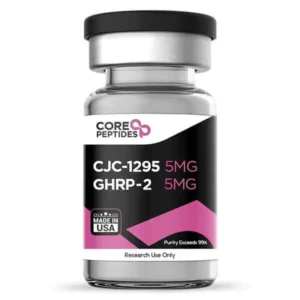
CJC-1295 ( Mod GRF 1-29 ) & Ipamorelin & GHRP-2 Blend ( 9mg )
Peptides Blends
Peptides Blends
Peptides Blends
Peptides Blends
Reviews
There are no reviews yet.