
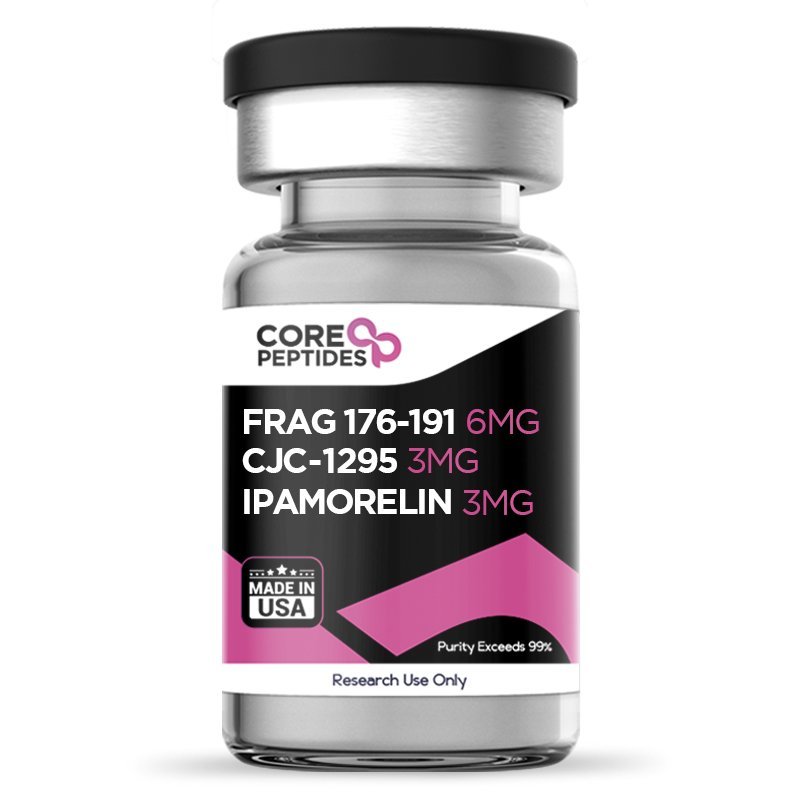
Fragment 176-191 & CJC-1295 & Ipamorelin Blend: A Buyer’s Guide
If you are looking to purchase a high-purity Fragment 176-191 & CJC-1295 & Ipamorelin Blend online, navigating the research chemical market can be challenging. Quality varies wildly between vendors. Understanding exactly what you are buying, how to verify its purity, and how the components interact is critical for any successful laboratory application.
This comprehensive guide breaks down the science, quality metrics, and buying considerations for this specific 12mg peptide blend.
Quick Facts & Product Highlights
-
Product Type: Multi-peptide compound blend
-
Total Content per Vial: 12mg total lyophilized (freeze-dried) powder [verify specific ratio breakdown per vial with brand]
-
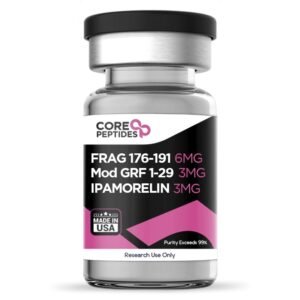
Included Components: Fragment 176-191, CJC-1295 (without DAC), and Ipamorelin
-
Purity Standard: Minimum 99% pure via third-party HPLC testing [verify with brand]
-
Format: Lyophilized cake/powder in a sterile glass vial
-
Primary Intended Use: In vitro laboratory research and comparative biochemical analysis
-
Ideal Target Buyer: Certified laboratory researchers, clinical institutions, and biochemical analysts requiring high-precision reference materials
What the Product Is
The Fragment 176-191 & CJC-1295 & Ipamorelin Blend (12mg) is a specialized formulation that combines three distinct synthetic peptide chains into a single delivery vial. Instead of sourcing, measuring, and combining these compounds independently, researchers utilize pre-formulated blends to ensure uniform ratios during comparative cellular studies.
To understand the blend, we must look at its three separate components:
-
Fragment 176-191: This is a modified segment of the human growth hormone (hGH) polypeptide chain, specifically spanning amino acids 176 through 191 at the C-terminus. It is isolated in research to study lipolytic pathways (fat breakdown mechanisms) without triggering the secondary insulin-like growth factor (IGF-1) or glycemic responses associated with full-length hGH.
-
CJC-1295 (typically without DAC): A synthetic analog of Growth Hormone-Releasing Hormone (GHRH). It contains 29 amino acids and acts as a secretagogue agonist, meaning it mimics natural signals to stimulate production pathways in cellular models.
-
Ipamorelin: A selective Growth Hormone Secretagogue (GHS) and ghrelin receptor agonist. It is a small 5-amino acid peptide (pentapeptide) frequently studied for its highly selective mechanism, as it does not significantly impact cortisol, prolactin, or aldosterone levels during baseline testing.
Key Benefits and Research Use Cases
In a laboratory environment, combining these three distinct mechanisms allows researchers to observe multi-pathway cellular signaling simultaneously.
- Dual-Pathway Secretagogue Synergy; CJC-1295 and Ipamorelin target two entirely different receptor sites on the pituitary cellular model. CJC-1295 acts on GHRH receptors, while Ipamorelin triggers the growth hormone secretagogue receptor (GHSR). In cellular research, activating both receptors concurrently typically demonstrates a synergistic release curve that is significantly higher than using either compound in isolation.
- Isolated Lipid Metabolism Modeling; Because Fragment 176-191 specifically targets lipolytic activity without activating growth or replication factors, researchers utilize this blend to track metabolic changes and fatty acid oxidation patterns while keeping growth hormone signaling pathways active via the other two secretagogues.
- Efficiency in Comparative Trials; Purchasing a verified 12mg blend reduces laboratory preparation time, minimizes pipetting errors during reconstitution, and provides a stable baseline for observing complex peptide interactions.
Quality, Purity, and Testing Standards
When evaluating any Fragment 176-191 & CJC-1295 & Ipamorelin blend, purity is the single most important metric. Because these chemicals are intended for highly precise research environments, trace contaminants, heavy metals, or structural anomalies can completely compromise your dataset.
The Gold Standard of Verification: Never rely on a brand’s text claims alone. High-quality peptides must be accompanied by a verifiable, batch-specific Certificate of Analysis (COA) generated by an independent, third-party analytical laboratory.
How to Evaluate This Product Before Buying
Before clicking checkout on any peptide supply site, run through this specific verification checklist to ensure your research materials are authentic:
| Verification Factor | What to Look For | Why It Matters |
| HPLC Testing | High-Performance Liquid Chromatography graph showing a clean, single sharp peak. | Confirms the exact purity percentage (look for greater than 98% or 99%). |
| Mass Spectrometry (MS) | Mass spec analysis verifying the molecular weight of each peptide in the blend. | Confirms the identity of the substance; ensures you aren’t buying a mislabeled compound. |
| Batch Serialization | A matching batch or lot number printed directly on the vial label and the COA. | Ensures the test results actually belong to the physical vial you received, not a batch from last year. |
| Vacuum Sealing | A tight, uniform lyophilized “cake” at the bottom of the vial that does not appear melted or heavily crystallized. | Confirms proper moisture removal during manufacture, which prevents rapid degradation. |
Storage, Handling, and Usage Considerations
To preserve the delicate structural integrity of the Fragment 176-191 & CJC-1295 & Ipamorelin Blend, strict storage protocols must be maintained from receipt to final disposal.
Initial Storage (Lyophilized State)
Upon delivery, the dry powder should be stored in a controlled temperature environment. For short-term preservation (under 90 days), standard refrigeration at $2^\circ\text{C}$ to $8^\circ\text{C}$ ($36^\circ\text{F}$ to $46^\circ\text{F}$) is sufficient. For long-term archiving, keep the vials frozen at $-20^\circ\text{C}$ or lower, completely protected from light exposure.
Reconstitution Protocol
When preparing the blend for analytical use, introducing a bacteriostatic or sterile liquid agent must be handled with care:
-
Allow the vial to naturally reach room temperature before introducing liquids to prevent thermal shock to the peptide chains.
-
Direct the stream of liquid down the interior glass wall of the vial rather than shooting it directly into the powder.
-
Do not shake the vial. Swirl the liquid gently in a smooth, circular motion until completely dissolved. Aggressive shaking can break the fragile peptide bonds, rendering the compound structurally useless for research.
Post-Reconstitution Life
Once liquid is introduced, the compound degrades rapidly. Keep the reconstituted vial refrigerated and utilize it within 14 to 21 days for maximum chemical stability [verify specific degradation guidelines with Core Peptides].
Expert Insight / Pro Tip
Analytical Note: Because this is a three-peptide blend, remember that the individual molecular weights vary. If your research depends heavily on exact molar concentrations of an individual component, always contact the supplier directly to verify the precise milligram allocation (e.g., is it a 4mg/4mg/4mg split, or a different ratio?) before mapping out your data metrics.
Why Choose CorePeptidesOfficial.com
At CorePeptidesOfficial.com, we understand that research reliability hinges on absolute transparency.
-
Independent, Multi-Tier Testing: Every batch of our Fragment 176-191 & CJC-1295 & Ipamorelin Blend (12mg) undergoes rigorous HPLC and Mass Spectrometry validation to guarantee purity thresholds.
-
Proactive Cold-Chain Infrastructure: Our products are stored and processed in temperature-optimized environments to prevent environmental degradation prior to shipping.
-
Clear Regulatory Compliance: We never disguise our products behind vague marketing terms. We explicitly state our intended use profiles, provide verifiable batch access, and support your lab with direct technical customer service.
Common Mistakes to Avoid
-
Buying from Vendors Lacking Batch Numbers: If a site shows a “generic” or blurred-out sample COA without a trackable batch number, avoid it. You have no way of knowing what is inside your specific vial.
-
Exposing Vials to Excessive Light and Heat: Leaving your delivery box sitting in a warm mailbox or under direct sunlight will heavily degrade the synthetic links inside the vial.
-
Assuming Pre-Mixed Means Lower Quality: Some researchers assume blends are lower quality due to potential cross-reactivity. When formulated correctly by a verified laboratory using high-grade lyophilizate, the peptides remain perfectly stable while dry.
Final Buying Guidance
The Fragment 176-191 & CJC-1295 & Ipamorelin Blend represents a powerful combination for advanced cellular, metabolic, and secretagogue research. However, the compound is only as good as the purity verification backing it up.
Ensure your laboratory timelines are fully aligned with proper cold-storage capabilities before ordering. When you are ready to secure your analytical compounds, ensure you review the live batch COA on our product page to cross-check purity configurations.
Explore the fully verified Fragment 176-191 & CJC-1295 & Ipamorelin Blend (12mg) catalog at Core Peptides today to ensure absolute precision for your next project.
Frequently Asked Questions
- What is the exact ratio of the three peptides inside this 12mg blend? The total weight of the combined active lyophilized powder is 12mg per vial. To get the exact structural breakdown of how many milligrams are dedicated to Fragment 176-191, CJC-1295, and Ipamorelin respectively, please reference the batch specific lab card or [verify with brand] directly via our support desk.
- Is this blend approved for human consumption or therapeutic use? No. This product is strictly manufactured, labeled, and sold for in vitro laboratory research, diagnostic testing, and chemical comparison purposes only. It is not approved by the FDA or international regulatory bodies for human or veterinary use, injection, or direct consumption.
- How long can the vial sit at room temperature during shipping? Lyophilized peptides are highly stable in their dry form and can safely withstand standard transit temperatures for several days without losing structurally significant potency. However, once received, they should immediately be transferred to cold storage ($2^\circ\text{C}$ to $8^\circ\text{C}$ or lower).
- What is the difference between CJC-1295 with DAC vs. without DAC? This blend utilizes CJC-1295 without DAC (Drug Affinity Complex). Without DAC, the peptide has a much shorter metabolic half-life in cellular models, allowing researchers to observe precise, acute spikes in pathway stimulation rather than a prolonged, continuous plateau.
- What liquid should be used to reconstitute this blend? For standard laboratory research applications, Sterile Bacteriostatic Water (water containing 0.9% benzyl alcohol) is typically utilized. The benzyl alcohol inhibits potential bacterial growth within the vial once the rubber septum has been pierced.
Be the first to review “Fragment 176-191 & CJC-1295 & Ipamorelin Blend ( 12mg )”
Related products
Peptides Blends
Tesamorelin & CJC-1295 (Mod GRF 1-29) & Ipamorelin Blend (12mg)
Peptides Blends
Peptides Blends
Peptides Blends
Peptides Blends
Peptides Blends
Peptides Blends
Reviews
There are no reviews yet.