
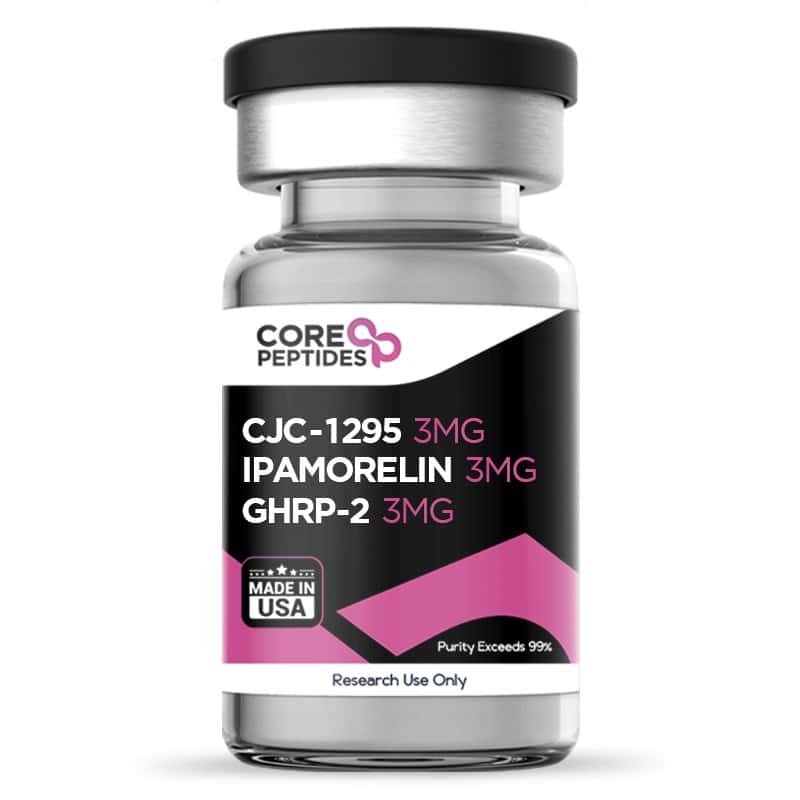
CJC-1295 (Mod GRF 1-29) & Ipamorelin & GHRP-2 Blend (9mg) Buyer’s Guide
Evaluating research materials requires absolute precision, transparency, and clear data. When investigating a growth hormone secretagogue (GHS) formulation, multi-peptide combinations are highly relevant to modern laboratory studies. The CJC-1295 (Mod GRF 1-29) & Ipamorelin & GHRP-2 Blend (9mg) is a specialized, trifecta formulation designed for in vitro and in vivo laboratory research. This guide provides an objective breakdown of this 9mg blend, its scientific rationale, quality benchmarks, and critical verification steps for researchers.
Product Highlights & Quick Facts
Before diving into the technical mechanics, here is a foundational summary of the compound:
-
Product Type: Multi-Peptide Combination Blend
-
Total Content: 9mg per vial (Typically blended as equal 3mg parts or specific ratio [verify with brand/source])
-
Active Ingredients: CJC-1295 (Mod GRF 1-29), Ipamorelin, GHRP-2
-
Format: Lyophilized (freeze-dried) white powder
-
Purity Standard: $\ge$ 98% (Verified via HPLC and Mass Spectrometry)
-
Primary Intended Use: In vitro laboratory research and comparative analytical studies
-
Storage Requirements: Refrigerator stable at 2°C to 8°C for short term; freezer stable at -20°C for long-term storage
-
Best-Fit Buyer: Qualified institutional researchers, laboratory managers, and analytical chemists seeking high-purity GHS synergy models
What Is the CJC-1295 & Ipamorelin & GHRP-2 Blend?
This primary search query refers to a combination of three distinct growth hormone secretagogues. In biochemical research, individual peptides often have single-channel pathways. By combining CJC-1295 (Mod GRF 1-29), Ipamorelin, and GHRP-2, researchers can study the concurrent activation of different receptor sites.
To understand the cjc1295 ipamorelin ghrp 2 blend, it helps to look at the three individual components:
-
CJC-1295 (Mod GRF 1-29): A synthetic analog of Growth Hormone-Releasing Hormone (GHRH). It consists of 29 amino acids and acts as a GHRH receptor agonist. Unlike modified versions with longer half-lives (like DAC), Mod GRF 1-29 preserves a more natural, pulsatile release profile in test models.
-
Ipamorelin: A selective Ghrelin Receptor Agonist and Growth Hormone Secretagogue (GHS). It mimics ghrelin to stimulate growth hormone release, but it is highly selective. It does not significantly alter cortisol, prolactin, or aldosterone levels during observation.
-
GHRP-2 (Growth Hormone Releasing Peptide-2): Another synthetic GHS that acts on the ghrelin receptor. However, it possesses a slightly different binding affinity and historical data profile compared to Ipamorelin. It is often studied for its complementary pulse intensity.
Why Blend These Three Peptides?
In literature, combining a GHRH analog with a GHRP is known to create a synergistic effect. While CJC-1295 acts like a gas pedal by signaling cells to produce more growth hormone, Ipamorelin and GHRP-2 work simultaneously to suppress somatostatin (the brakes) and trigger an immediate release. This three-pronged approach allows researchers to observe amplified signaling pathways without escalating the baseline mass volume of a single compound.
Key Research Benefits and Use Cases
The cjc-1295 & ipamorelin & ghrp-2 blend is frequently utilized in comparative cellular biology and metabolic research. Scientists examine this specific 9mg configuration to study several phenomena:
-
Synergistic Signaling Mechanisms: Investigating how concurrent GHRH and dual-GHRP stimulation affects cellular signaling cascades compared to single-peptide exposures.
-
Pulsatile Release Dynamics: Analyzing the amplitude and duration of growth hormone pulses when modulated by multiple secretagogues with varying half-lives.
-
Receptor Desensitization Profiles: Determining whether a multi-channel blend alters the rate at which target receptors downregulate or desensitize over prolonged exposure.
-
Tissue-Specific Cellular Repair: Assessing how downstream biomarkers (such as IGF-1 modulation) impact cellular turnover, nitrogen retention, and protein synthesis in vitro.
Compliance Reminder: This compound is strictly engineered, manufactured, and sold for laboratory research purposes only. It is not approved for human consumption, therapeutic use, or diagnostic procedures.
CJC-1295 (Mod GRF 1-29) & Ipamorelin & GHRP-2 Blend (9mg) Quality, Purity, and Testing Standards
When buying a cjc-1295 & ipamorelin & ghrp-2 blend for sale, purity is the single most important variable. Because this is a multi-peptide mixture, testing is more complex than evaluating a single compound. A reliable provider must demonstrate rigorous analytical verification.
+-------------------------------------------------------------------------+
|                    CRITICAL PURITY METRICS TO VERIFY                    |
+-------------------------------------------------------------------------+
| High-Performance Liquid Chromatography (HPLC) -> Confirms Purity >= 98% |
| Mass Spectrometry (MS)                         -> Verifies Amino Weight |
| Visual Inspection                              -> Lyophilized Cake Form |
+-------------------------------------------------------------------------+
-
HPLC Testing: High-Performance Liquid Chromatography separates the components within the vial. For a blend, the resulting chromatogram chart should show clean, distinct peaks corresponding to the exact molecular weight of each peptide, with zero unexplained variance or heavy baseline noise.
-
Mass Spectrometry (MS): This verifies the identity of the molecules by measuring their mass-to-charge ratio. This guarantees that you are actually receiving authentic CJC-1295, Ipamorelin, and GHRP-2, rather than mislabeled alternative sequences.
-
Lyophilization Standards: A proper freeze-drying process ensures the material remains highly stable. The contents should appear as a solid, uniform “cake” or uniform powder mass at the bottom of the glass vial, free of visible moisture or discoloration.
How to Evaluate This CJC-1295 (Mod GRF 1-29) & Ipamorelin & GHRP-2 Blend (9mg) Before Buying
Not all research chemicals are manufactured equally. Before finalizing a procurement order for a cjc-1295 & ipamorelin & ghrp-2 configuration, run through this verification checklist to protect your laboratory data:
-
Request a Verified Certificate of Analysis (COA): A legitimate vendor must provide a COA that matches the current batch number on your vial. Check the date of the test to ensure it is recent.
-
Verify Third-Party Lab Credentials: Ensure the testing was completed by an independent, domestic, or internationally recognized analytical laboratory, rather than an in-house or unverified source.
-
Confirm the Exact Mass Ratio: Because this is a 9mg blend, you need to know the breakdown. For example, is it an even 3mg/3mg/3mg split, or a custom balance? Always verify this layout on the product page or certificate [verify with brand/source].
-
Check for Proper Labeling: Vials should clearly state the exact contents, total milligram mass, batch tracking ID, and explicit “Research Use Only” language.
Storage, Handling, and Usage Considerations
To preserve the structural integrity of the cjc-1295 & ghrp-2 blend, adherence to precise laboratory handling protocols is mandatory.
-
Prior to Reconstitution: Keep the lyophilized vials stored in a temperature-controlled environment. For short-term windows, standard refrigeration (2°C to 8°C) is sufficient. For prolonged preservation, store at sub-zero temperatures (-20°C or lower) to prevent peptide degradation.
-
The Reconstitution Process: When introducing a bacteriostatic or sterile laboratory solvent, avoid direct, high-pressure streams onto the lyophilized powder. Instead, aim the liquid down the inner glass wall of the vial.
-
Post-Reconstitution Care: Peptides are delicate, fragile structures held together by sensitive peptide bonds. Do not shake or vigorously agitate the vial after liquid introduction. Gently swirl the vial until the cake completely dissolves. Store the liquid solution strictly between 2°C to 8°C and use within the recommended laboratory testing window [verify specific stability days with source].
Expert Insight / Pro Tip
Analytical Note: When running analytical assays or software-based chromatography on a multi-peptide matrix like the cjc-1295 & ipamorelin & ghrp-2, always calibrate your equipment for individual retention times. Because different secretagogues interact with column matrices at varying rates, running a baseline blank sample of each separate peptide beforehand will make reading your blended results significantly cleaner.
Why Choose CorePeptidesOfficial.com?
Core Peptides is dedicated to serving the scientific community with uncompromised, laboratory-grade compounds. When sourcing a cjc 1295 plus ipamorelin or triple-blend sequence from our catalog, you are secured by:
-
Transparent Batch Tracking: Every batch is assigned a unique identifier, allowing you to trace your material directly back to its analytical testing sequence.
-
Independent Quality Assurance: We do not grade our own homework. Every single batch undergoes third-party verification to confirm it meets or exceeds our strict $\ge$ 98% purity standard.
-
Cold-Chain Delivery Standards: We pack and ship our compounds utilizing protective materials engineered to minimize thermal fluctuations and physical vibration during transit.
Common Mistakes to Avoid
-
Confusing with Alternative Blends: Be careful not to confuse this item with a cjc-1295 & ghrp-6 blend or a simple cjc-1295 & ghrp-2 dual-mix. GHRP-6 has a drastically different affinity profile and significantly increases hunger responses in animal models, which could skew your data if ordered by mistake.
-
Accepting Missing COAs: Never purchase a multi-peptide formulation based on word-of-mouth or generic text assurances. If a vendor cannot or will not produce a valid third-party HPLC report for that specific batch, do not risk your project budget.
-
Improper Climate Management: Allowing lyophilized vials to sit in fluctuating room temperatures or direct sunlight can cause rapid denaturation, rendering your research variables inaccurate.
Final Buying Guidance
Sourcing the right CJC-1295 (Mod GRF 1-29) & Ipamorelin & GHRP-2 Blend (9mg) comes down to verifying the math and data behind the vial. Ensure your laboratory equipment is fully calibrated for a triple-secretagogue compound, confirm the current batch COA documents, and maintain appropriate cold-chain protocols immediately upon arrival.
If you are ready to secure highly consistent, fully verified compounds for your ongoing studies, review our available inventory, verify our latest independent laboratory logs, and select the optimal quantity for your timeline.
Frequently Asked Questions
- What is the exact ratio of the three peptides in this 9mg blend? The 9mg total mass typically represents a balanced, equal distribution of 3mg of CJC-1295, 3mg of Ipamorelin, and 3mg of GHRP-2 per vial. However, you should always check the active batch label or spec sheet to confirm the exact formulation matrix before beginning an assay [verify with brand/source].
- How do I read the HPLC chart for a triple peptide blend? Unlike a single-peptide chart which features one primary dominant peak, a blended HPLC chromatogram will showcase three distinct main peaks representing each separate peptide sequence as they elute from the column. The total area under these peaks determines the ultimate purity percentage.
- Can this blend be stored at room temperature? Lyophilized powder can tolerate short periods at room temperature during shipping transit, but long-term exposure will accelerate degradation. It should be transferred to dedicated refrigeration or freezer units immediately upon receipt at your facility.
- What is the difference between this product and a cjc-1295 & ghrp-6 blend? The difference lies in the specific Growth Hormone Releasing Peptide used. This product features Ipamorelin and GHRP-2. A GHRP-6 variant utilizes a different amino sequence that strongly binds to receptors that trigger intense appetite stimulation and alternative side-biomarkers, which may conflict with specific research goals.
- Is this compound safe for human clinical trials? No. This 9mg blend is prepared, labeled, and sold strictly for laboratory evaluation and in vitro research purposes. It is not approved by regulatory bodies for human administration, therapy, or over-the-counter wellness applications.
Be the first to review “CJC-1295 (Mod GRF 1-29) & Ipamorelin & GHRP-2 Blend (9mg)”
Related products
Peptides Blends
Peptides Blends
Peptides Blends
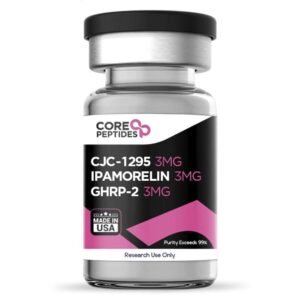
CJC-1295 ( Mod GRF 1-29 ) & Ipamorelin & GHRP-2 Blend ( 9mg )
Peptides Blends
Peptides Blends
Peptides Blends
Peptides Blends
Reviews
There are no reviews yet.