
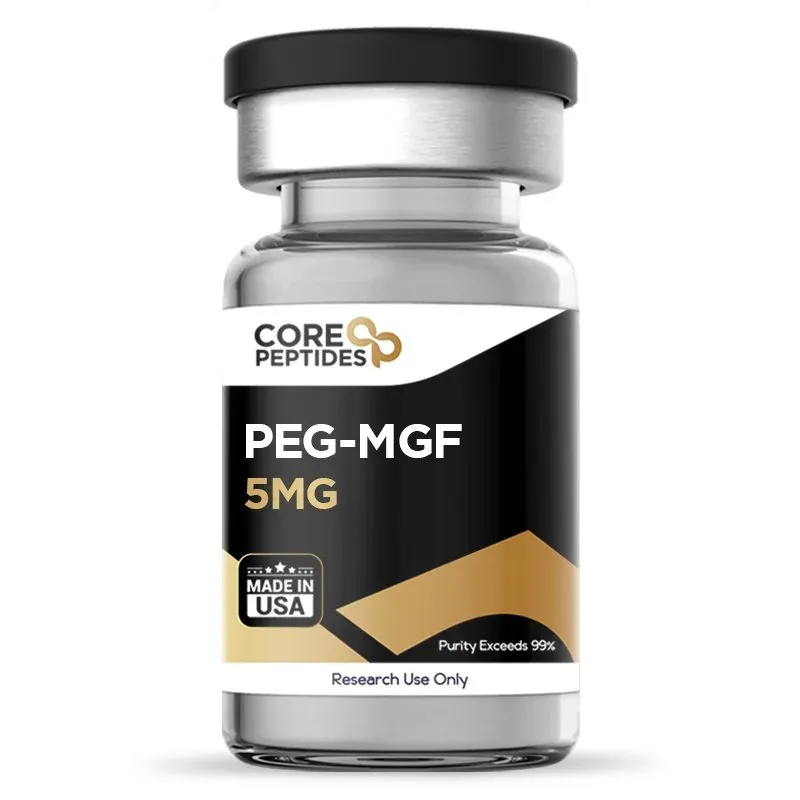
PEG-MGF Peptide Buying Guide: Quality, Science, and Research Insights
If you are looking to purchase PEG-MGF, ensuring you source highly pure, laboratory-grade compounds is essential for accurate and reproducible research results. Mechano-Growth Factor (MGF) is a variant of Insulin-like Growth Factor-1 (IGF-1), but its native form breaks down in the body within minutes. To solve this problem, structural researchers developed PEG-MGF peptide, which attaches a polyethylene glycol (PEG) molecule to the peptide chain. This process, known as pegylation, stabilizes the compound and extends its half-life significantly.
Understanding the difference between raw, unpegylated MGF and high-grade PEG-MGF is critical before making a procurement decision. This comprehensive guide breaks down the science, quality indicators, and purchasing considerations for your laboratory.
Product Highlights & Quick Facts
-
Product Type: Pegylated Mechano-Growth Factor (PEG-MGF)
-
Standard Format: Lyophilized (freeze-dried) white powder
-
Target Formulation: 5mg vial
-
Minimum Purity Standard: Greater than or equal to 98% [verify with brand/source]
-
Primary Modification: Polyethylene Glycol (PEG) polymer chain attachment
-
Testing Protocol: HPLC (High-Performance Liquid Chromatography) and Mass Spectrometry
-
Intended Use: In vitro and in vivo laboratory research use only
-
Best-Fit Buyer: Biomedical researchers, laboratory technicians, and institutional buyers
What Is the PEG-MGF Peptide?
To understand pegylated MGF, it helps to look at how the body naturally handles tissue stress. When muscle tissue experiences mechanical stress or load, the IGF-1 gene splices into two primary variants: IGF-1Ea and IGF-1Eb (commonly called Mechano-Growth Factor or MGF).
In its natural state, MGF acts locally to stimulate cellular repair, satellite cell activation, and new tissue growth. However, native MGF suffers from extreme susceptibility to enzymatic degradation, giving it a biological half-life measured in mere minutes.
By binding a non-toxic polyethylene glycol molecule to the MGF peptide molecule, scientists created PEG-MGF. This modification creates a protective barrier around the peptide chain. It does not alter the core mechanism of action, but it reduces rapid renal clearance and enzymatic breakdown. This extension shifts the compound’s availability from minutes to several days, making systematic cellular research viable in laboratory models.
Key Areas of Research Study
While peptide PEG-MGF is strictly restricted from human consumption, it is widely studied across several biomedical disciplines. In laboratory environments, researchers look at how the extended half-life influences cellular behaviors:
-
Satellite Cell Activation: Researchers observe how the compound triggers the proliferation of dormant muscle stem cells (satellite cells), which are essential for tissue regeneration.
-
Cardioprotection Studies: Some research models look into whether the prolonged availability of MGF can help protect cardiac tissue during localized hypoxia (oxygen deprivation).
-
Bone and Cartilage Repair: Studies investigate the role of localized MGF signaling in accelerating healing pathways within bone fractures and chondrocyte (cartilage cell) matrices.
Quality, Purity, and Testing Standards
When looking at PEG-MGF for sale, superficial website designs matter far less than empirical laboratory data. Because peptides are synthesized via complex chemical sequences, impurities like truncated sequences or residual solvents can compromise your study.
Every batch of PEG-MGF (5mg) must undergo strict analytical verification. A trustworthy supplier provides access to two primary validation methods:
-
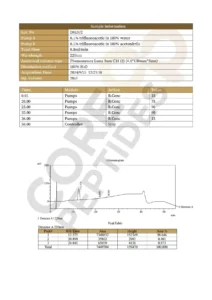
HPLC (High-Performance Liquid Chromatography): This separates the components of the mixture to verify the exact purity percentage. Look for batches that test at 98% or higher purity.
-
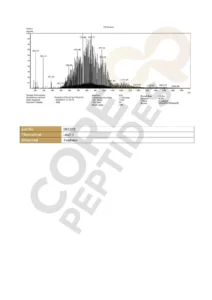
Mass Spectrometry (MS): This verifies the identity of the molecule by measuring its precise molecular mass, ensuring the compound is actually PEG-MGF and not a mislabeled alternative.
How to Evaluate This Product Before Buying
Before completing a checkout for buy peg-mgf options online, run through a strict verification checklist to protect your research budget and safety:
Check the Certificate of Analysis (COA)
A real COA must be batch-specific, not a static image hosted on a website for years. Ensure the document shows a clear matching batch or lot number, a visible date of analysis, and an independent laboratory’s signature.
Evaluate Product Labeling
Compliant vendors always label their products explicitly with “Research Use Only” or “Not for Human Consumption” text. Avoid suppliers using vague, evasive phrasing or those marketing products for personal physical transformation.
Inspect the Shipping Standards
Because lyophilized peptides are sensitive to extreme temperatures, ask your vendor about their thermal packaging choices and typical transit timelines.
Storage and Handling Considerations
Maintaining the stability of your MGF peptide requires careful environmental management. For optimal shelf life, follow standard cold-chain laboratory protocols:
-
Pre-reconstitution (Lyophilized Powder): Store the dry powder at -20°C for long-term stability up to 24 months. For short-term storage under 3 months, standard refrigeration at 2°C to 8°C is typically acceptable.
-
Post-reconstitution (Liquid Form): Once mixed with a bacteriostatic or sterile water solvent, the structural stability degrades faster. Keep reconstituted PEG-MGF strictly at 2°C to 8°C and use within 20 to 30 days [verify with brand/source]. Never freeze a peptide after it has been reconstituted.
Expert Insight / Pro Tip: When reconstructing your 5mg vial, never spray your reconstitution solvent directly onto the freeze-dried powder cake. The sheer force can break down the delicate peptide bonds. Instead, angle your syringe toward the glass vial wall and let the liquid slide down slowly, then gently swirl—do not shake—the vial.
Why Choose CorePeptidesOfficial.com?
At Core Peptides Official, we recognize that your research outcomes depend entirely on product consistency. We eliminate the guesswork from sourcing pegylated mgf for sale by adhering to rigorous quality standards.
-
Transparent Verification: Every batch is fully traceable with accessible, independent third-party HPLC and MS testing reports.
-
Lyophilization Precision: Our precise vacuum-drying process ensures maximum structural stability during transit and storage.
-
Secure Logistics: We implement highly reliable, temperature-optimized packaging protocols to guarantee product integrity globally.
Common Mistakes to Avoid
-
Confusing MGF with PEG-MGF: Standard MGF degrades too quickly for systemic or extended cell culture models. Ensure your protocol specifically calls for pegylated variants if you need a prolonged half-life.
-
Purchasing Based on Price Alone: Deeply discounted peptides are often a red flag for low-purity batches, residual heavy metals, or completely inaccurate vial dosing.
-
Exposing Vials to Direct Light: Ultraviolet light degrades peptide structures. Keep your vials stored in their original boxes or dark storage environments.
Final Buying Guidance
Sourcing your laboratory reagents demands a high level of diligence. If you are ready to buy pegylated mgf, verify that your research budget aligns with verified third-party data rather than unbacked claims.
Ready to review the chemical profile of our current inventory? Inspect our updated testing sheets and secure your batch at CorePeptidesOfficial.com.
Frequently Asked Questions
-
What is the exact half-life of PEG-MGF compared to standard MGF?
Standard MGF possesses a biological half-life of only a few minutes in vivo. Due to the attached polyethylene glycol chain, PEG-MGF extends this window significantly, remaining active in research models for several days.
-
Can PEG-MGF be stored at room temperature?
It can tolerate room temperature during brief shipping windows, but it should be placed in a controlled refrigerator (2°C to 8°C) or freezer (-20°C) immediately upon arrival to avoid degradation.
-
How do I read the purity percentage on my COA?
The HPLC graph will show a primary peak representing the target compound. The area under that specific peak relative to minor impurity peaks determines the final purity percentage, which should be $\ge 98\%$.
-
What liquid should be used to reconstitute PEG-MGF (5mg)?
Laboratory protocols generally utilize Bacteriostatic Water (0.9% benzyl alcohol) to inhibit potential bacterial growth, or Sterile Water for short-term single-use applications.
-
Is this product safe for human trial evaluation?
No. All compounds sold on CorePeptidesOfficial.com are strictly intended for laboratory in vitro (test tube) and in vivo (animal model) scientific research. They are not cleared or intended for human medical use, diagnosis, or therapy.
Certificate of Analysis
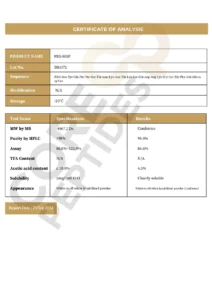
HPLC
Mass Spectrometry
Be the first to review “PEG-MGF (5mg)”
Related products
Peptides
Reviews
There are no reviews yet.