
Buy LL-37 (5mg) Online: The Definitive Research Buyer’s Guide
If you are looking to buy LL-37 for your laboratory, navigating the research chemical market can be challenging. Quality, stability, and testing transparency vary wildly between vendors. This guide breaks down everything you need to know about the LL-37 peptide, how to evaluate its purity, and what to verify before purchasing for your research facility.
Product Highlights & Quick Facts
-
Product Type: Antimicrobial Research Peptide (Cathelicidin family)
-
Format: Lyophilized (freeze-dried) white powder
-
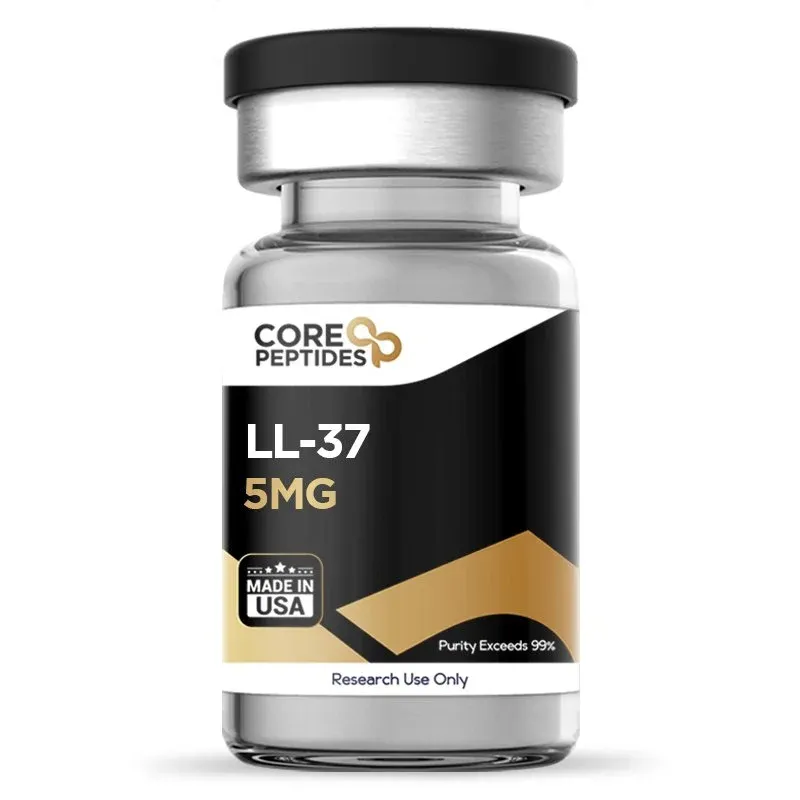
Purity Standard: Greater than or equal to 99% [verify with brand certificate]
-
Unit Size: 5mg per vial
-
Intended Use: In vitro laboratory research and in vivo animal modeling only
-
Storage Requirement: Temperature-controlled, desiccated, dry environment
-
Ideal Buyer: Certified academic institutions, biotech firms, and independent laboratory researchers
What is the LL-37 Peptide?
LL-37 is a 37-amino acid, amphipathic, helical peptide. It belongs to the cathelicidin family of antimicrobial peptides (AMPs). In nature, it is cleaved from the hCAP18 proprotein, primarily expressed in immune cells like neutrophils and epithelial barrier cells.
In laboratory settings, synthetic peptide LL-37 is heavily studied for its unique structural properties. Because it possesses both hydrophobic (water-repelling) and hydrophilic (water-attracting) faces, it interacts dynamically with lipid bilayers. Researchers buy ll37 primarily to study its role in cell membrane disruption, immune signaling pathways, and tissue remodeling models.
Key Research Use Cases & Benefits
While grey-market wellness spaces often discuss ll-37 peptide for personal optimization, legitimate chemical supply chains categorize it strictly for laboratory evaluation. In validated scientific literature, the primary use cases include:
-
Antimicrobial Membrane Dynamics: Researchers utilize ll 37 to observe how the peptide targets and destabilizes the cell walls of various bacterial strains without damaging host-cell mechanics.
-
Cell Signaling & Chemotaxis: The peptide acts as a ligand for various formyl peptide receptors. This allows scientists to map out how immune cells migrate to sites of injury or infection.
-
Angiogenesis Models: In vitro assays use the IL-37 peptide to study the proliferation of endothelial cells and the formation of new blood vessel structures.
Quality, Purity, and Testing Standards
When buying an ll-37 peptide 5mg vial, structural purity dictates the validity of your experimental data. Impurities or leftover synthesis reagents can easily skew assay results.
Premium manufacturing requires rigorous testing pipelines:
-
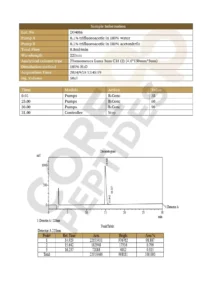
High-Performance Liquid Chromatography (HPLC): Separates and quantifies the target peptide from synthesis byproducts to ensure exact mass purity.
-
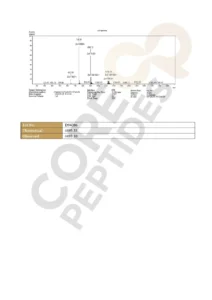
Mass Spectrometry (MS): Confirms the exact molecular weight of the 37-amino acid sequence, ensuring no structural degradation occurred during synthesis.
Purity Threshold: Never accept research materials with a purity rating under 98%. CorePeptidesOfficial.com targets a standard of 99% purity or greater on every structural batch [verify with brand/source].
How to Evaluate LL-37 Before Buying
Before clicking checkout on any ll-37 for sale listing, run through this verification checklist to protect your budget and your lab’s integrity:
-
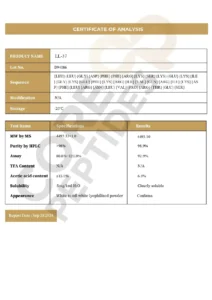
Demand a Batch-Specific COA: A Certificate of Analysis (COA) should not be a static image from three years ago. Ensure the COA dates match recent manufacturing batches.
-
Check the Labeling: Legitimate vendors clearly print “For Research Use Only” (RUO) on the vial. Avoid vendors who use ambiguous language to bypass compliance rules.
-
Examine the Physical Form: High-quality synthetic ll37 peptides should appear as a uniform, white, lyophilized cake or powder cake. Discoloration or heavy clumping indicates moisture intrusion or poor vacuum sealing.
Storage, Handling, and Usage Considerations
Synthetic peptides are inherently fragile molecules. To maintain the structural stability of your ll 37 peptide 5mg vials, adhere to standard cold-chain protocols:
Initial Storage (Pre-Reconstitution)
Keep the lyophilized powder at $-20^\circ\text{C}$ for long-term storage. For short-term use within a few weeks, standard refrigeration at $2^\circ\text{C}$ to $8^\circ\text{C}$ is acceptable, provided the vial remains tightly sealed against ambient humidity.
Reconstitution Protocol
When preparing ll-37 peptide dosage solutions for your assays, use sterile, bacteriostatic water or laboratory-grade sterile saline [verify exact reconstitution fluid with brand instructions].
Expert Insight / Pro Tip
The Syringe Filter Trap: Because LL-37 is highly amphipathic, it has a natural affinity for sticking to plastic and certain membrane surfaces. If your lab protocol requires sterile filtration after reconstitution, avoid using hydrophobic PVDF or nylon filters, as they can pull the peptide right out of your solution. Instead, opt for low-protein-binding PES (polyethersulfone) filters to maximize your yield recovery.
Why Buy From CorePeptidesOfficial.com?
CorePeptidesOfficial.com balances premium biotech synthesis with institutional-grade supply security.
-
Complete Transparency: Every batch of ll-37 peptide buy orders is accompanied by verifiable, independent third-party testing documentation.
-
Vacuum-Sealed Packaging: Vials are sealed under an inert gas blanket to maximize stability during transit and eliminate degradation risk.
-
Global Logistics Competence: Temperature-monitored shipping channels ensure your order arrives with molecular integrity completely intact, whether you are buying locally or globally.
Common Mistakes to Avoid
-
Confusing the Formats: Do not purchase pre-dissolved liquid peptides from unverified vendors. Peptides degrade rapidly in liquid form; always buy ll-37 5mg in its stable, lyophilized powder state.
-
Skipping Batch Checking: Never assume a new shipment behaves identically to the last one. Always check the batch number on the vial against your vendor’s records before starting a new round of experiments.
-
Improper Media Choice: Using the wrong pH buffer during reconstitution can cause immediate precipitation. Double-check your specific assay requirements against the peptide’s isoelectric point.
Final Buying Guidance
The ll-37 peptide is a powerful tool for cellular and antimicrobial research, but your data is only as good as your source material. Ensure you are purchasing from a vendor that values third-party verification over marketing hype.
If you are ready to secure high-purity, batch-verified materials for your laboratory, explore the options available at CorePeptidesOfficial.com.
Frequently Asked Questions
- What is the exact sequence length of LL-37? LL-37 is a 37-amino acid peptide with the sequence LLGDFFRKSKEKIGKEFKRIVQRIKDFLRNLVPRTES. It has a molecular weight of approximately $4493.3\text{ g/mol}$.
- Can I buy LL-37 for personal therapeutic use? No. LL-37 sold on CorePeptidesOfficial.com is strictly for laboratory research, in vitro analysis, and animal study models. It is not approved for human consumption, medical treatments, or diagnostic procedures.
- How long does a lyophilized vial last in storage? When stored properly in a sealed desiccated container at $-20^\circ\text{C}$, a lyophilized vial can remain stable for up to 24 months [verify exact stability timeline with brand].
- What should I do if my peptide cake looks broken during shipping? It is completely normal for the lyophilized peptide cake to crack or shift into a loose powder format during transit. As long as the vacuum seal remains intact, this does not affect the purity or efficacy of the product.
- How do I access the COA for my specific batch of LL-37? You can download your batch-specific Certificate of Analysis directly from CorePeptidesOfficial.com by entering the unique batch number printed on your vial’s label at checkout or via our testing database portal [verify database link with brand].
Certificate of Analysis
HPLC
Mass Spectrometry
Be the first to review “LL-37 (5mg)”
Related products
Peptides
Peptides
Reviews
There are no reviews yet.