
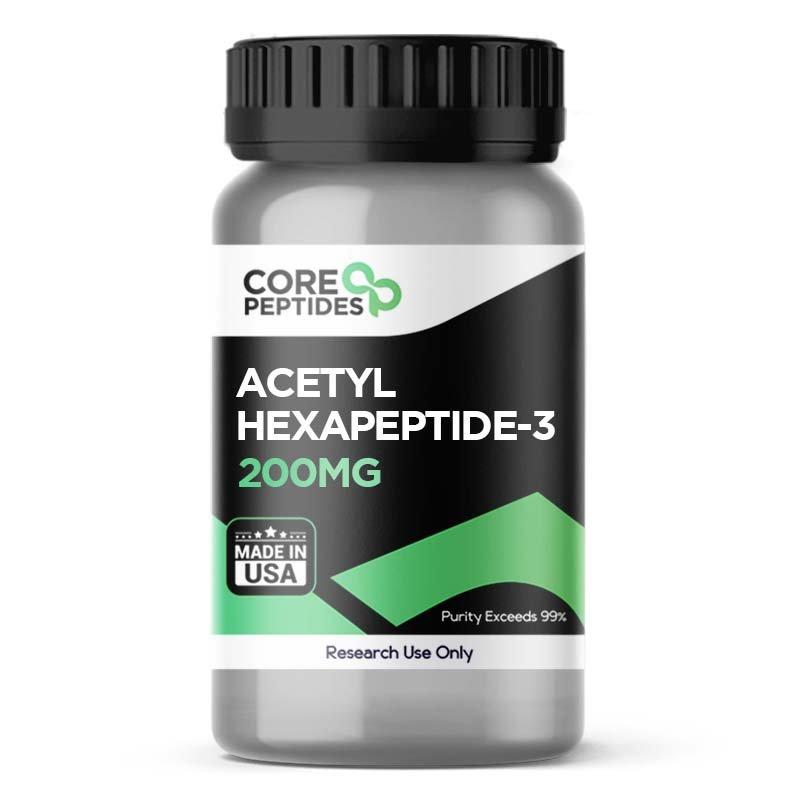
Acetyl Hexapeptide 3: A Guide to Argireline 200mg for Research
If you are sourcing acetyl hexapeptide 3 for your laboratory, understanding its chemical profile, stability, and purity standards is essential. Also widely recognized in scientific literature as acetyl hexapeptide-3 or argireline acetyl hexapeptide 3, this compound is one of the most heavily studied synthetic peptides in structural biology and cellular biochemistry.
When conducting in vitro or biochemical assays, research accuracy depends entirely on the quality of your reagents. This comprehensive guide details the technical specifications, quality benchmarks, and sourcing parameters for Acetyl Hexapeptide-3 (Argireline) 200mg.
Quick Facts & acetyl hexapeptide 3 Highlights
-
Product Type: Synthetic Peptide / Hexapeptide Oligomer
-
Primary Name: Acetyl Hexapeptide-3 (Synonym: Argireline, Acetyl Hexapeptide-8)
-
Format: Lyophilized (freeze-dried) white powder
-
Mass / Quantity: 200mg per vial
-
Purity Standard: ≥98% [verify with brand/source] via HPLC & Mass Spectrometry
-
Intended Use: In vitro laboratory research and comparative assays only
-
Storage Requirements: Store at -20°C for long-term stability; avoid moisture exposure
What the Acetyl hexapeptide 3 Is
Acetyl hexapeptide 3 is a synthetically produced peptide chain consisting of six amino acids configured with an acetylated N-terminus. In scientific circles, the terms hexapeptide 3, hexapeptide-3, and argireline hexapeptide are used interchangeably to describe this specific molecular structure.
Chemically, it mimics a fragment of the SNAP-25 protein, a substrate of the botulinum neurotoxin. Researchers study this acetyl hexapeptide sequence to analyze how it interacts with the SNARE protein complex, which regulates vesicle fusion and cellular exocytosis.
Because of its unique sequence, it serves as a foundational benchmark when evaluating other structural variations, such as hexapeptide 9, hexapeptide 10, hexapeptide-17, and broader classes of hexapeptides.
acetyl hexapeptide 3 Key Benefits and Research Use Cases
In laboratory environments, researchers utilize acetyl hexapeptide 3 argireline to explore a variety of cellular pathways. The primary acetyl hexapeptide 3 benefits documented in structural biology studies include:
-
SNARE Complex Inhibition Models: Investigating how the peptide competes with native proteins to modulate cellular signaling pathways.
-
Cellular Longevity Assays: Analyzing cell viability, fibroblast behavior, and collagen matrix retention in laboratory tissue cultures.
-
Comparative Peptide Studies: Serving as a control baseline to evaluate the efficacy of more complex chains, such as acetyl octapeptide 3 or acetyl hexapeptide 38.
While consumer-facing acetyl hexapeptide 3 cream formulations and topical acetyl hexapeptide 3 products exist in the consumer cosmetics industry, raw lyophilized powders are strictly designated for analytical evaluation. They allow researchers to study the pure molecule without confounding variables like emulsifiers, preservatives, or lipid carriers.
Acetyl Hexapeptide 3 Quality, Purity, and Testing Standards
High-purity reagents prevent experimental drift and false positives. For a complex acetyl hexapeptide chain, standard manufacturing must meet stringent criteria:
-
High-Performance Liquid Chromatography (HPLC): This analytical technique confirms the purity percentage by separating individual molecular components. High-grade research material should display a sharp, distinct peak indicating verified purity.
-
Mass Spectrometry (MS): This process verifies the precise molecular weight of the hexapeptide chain, confirming that the amino acid sequence matches the theoretical structure of Argireline exactly.
-
Lyophilization Consistency: The moisture-removal process ensures the 200mg cake dissolves uniformly upon reconstitution, preserving the integrity of the peptide bonds during storage.
How to Evaluate acetyl hexapeptide-3 Before Buying
When purchasing research peptides online, transparency is your best safeguard. Before adding a product to your inventory, confirm the following details:
-
Certificate of Analysis (COA): A reliable supplier provides an authentic, accessible COA for each batch number. Check that the document reflects recent testing dates.
-
Batch Tracking: Ensure the label on your vial matches the specific batch paperwork provided by the vendor.
-
Purity Level: Ensure the batch meets or exceeds analytical standards (typically 98% or higher) [verify with brand/source].
-
Label Clarity: The product must clearly specify its exact content (e.g., Acetyl Hexapeptide-3 200mg) along with strict laboratory-use labeling.
Storage, Handling, and Usage Considerations
Proper preservation protects the delicate peptide bonds from degradation.
-
Unreconstituted Powder: Keep the lyophilized vial sealed and stored at -20°C. For short-term transit or initial handling, storage at 2°C to 8°C is acceptable but should not be prolonged.
-
Reconstitution Environment: Always handle the product in a sterile laminar flow hood. Use appropriate laboratory diluents according to your specific assay protocol.
-
After Reconstitution: Once liquid is introduced, the solution should be stored between 2°C and 8°C and used within a tight testing window [verify specific stability windows with brand/source] to avoid hydrolysis. Avoid manual agitation or violent shaking, as structural proteins can shear.
Expert Insight: Navigating the Hexapeptide Family
Pro Tip: When designing comparative research matrices, it helps to understand how different modifications alter peptide behavior. For example, acetyl hexapeptide-1 and acetyl hexapeptide 1 are studied for their distinct pathways involving melanocortin receptors. Meanwhile, structural extensions like acetyl octapeptide 3 (eight amino acids) are frequently evaluated alongside acetyl hexapeptide 8 and acetyl octapeptide 3 pairings to observe compound synergy in cellular structural dynamics. Knowing these distinctions prevents misordering during chemical procurement.
Why Choose CorePeptidesOfficial.com
CorePeptidesOfficial.com is dedicated to providing laboratory professionals with verified, stable, and highly pure compounds.
-
Purity Verification: Every batch undergoes strict testing protocols to ensure your research integrity remains uncompromised.
-
Secure Logistics: Vials are packed securely to withstand temperature fluctuations during transit, arriving at your lab intact.
-
Comprehensive Documentation: We provide access to verified batch information, leaving no guesswork for your laboratory compliance needs.
Common Mistakes to Avoid
-
Confusing Research Grads with Finished Products: Do not mistake bulk lyophilized powders for finished cosmetic formulations. This raw compound is not a ready-to-use cream.
-
Improper Reconstitution Volume: Inaccurate mathematical calculations during dilution can skew your final concentration metrics, leading to inconsistent assay results.
-
Ignoring Temperature Fluctuations: Leaving vials at room temperature for extended periods accelerates degradation, diminishing the active yield of the hexapeptide-3.
Final Buying Guidance
Sourcing acetyl hexapeptide 3 requires a partner that understands the rigorous demands of laboratory research. Before completing your order at CorePeptidesOfficial.com, double-check your protocol’s volume requirements to determine if a 200mg concentration fits your testing schedule perfectly.
Ready to secure premium-grade reagents for your next project? View the complete specifications and secure your supply directly on our item page.
Frequently asked Questions
What is the difference between acetyl hexapeptide 3 and Argireline? There is no chemical difference. Argireline is the widely recognized commercial trade name for the generic peptide sequence known as acetyl hexapeptide-3 (and sometimes acetyl hexapeptide-8).
Can this product be used directly on the skin? No. This is a highly concentrated, raw lyophilized chemical substance intended solely for in vitro laboratory research and analytical testing. It is not a finished cosmetic product and should not be applied directly to the skin.
How should I reconstitute the 200mg vial? Reconstitution protocols depend entirely on your specific laboratory assay design. Generally, bacteriostatic water or sterile saline is injected gently down the side of the vial wall. Always consult your project’s standard operating procedures (SOPs).
What is the shelf life of the lyophilized powder? When stored continuously at -20°C and protected from light and moisture, the freeze-dried peptide remains stable for up to several years [verify with brand/source].
Are third-party lab results available for this batch? Yes. CorePeptidesOfficial.com provides batch-specific documentation, including HPLC and MS verification, to confirm purity and identity before your purchase [verify with brand/source].
Be the first to review “Acetyl Hexapeptide-3 ( Argireline ) ( 200mg )”
Related products
Peptides
Peptides
Reviews
There are no reviews yet.